When to Send Simcha Invitations: A Timing Guide for Every Simcha
How far ahead families commonly send invitations for a sholom zucher, bris, pidyon haben, kiddush, tenoyim, l'chaim, chasuna, sheva brachos, bavarfen, bar mitzvah, siyum and upsherin, with Shabbos, Yom Tov and Jewish-calendar tips.
Updated November 8, 2026
Timing depends on the simcha
Some simchas are planned for months. Others are known only a few days ahead, or a few hours: a sholom zucher depends on when the baby is born, a bris depends on the baby's health, and a l'chaim happens the night the shidduch is closed. So there is no one rule for "how early to send". There is common practice for each simcha, and this guide collects it in one place.
Everything here is common practice, not halacha and not a rule. Families, communities and chassidus differ. When something touches halacha, such as the day of a bris or a pidyon haben, the date is set with your Rav and the mohel or kohen, and the invitation simply follows.
The timing table
A quick overview. The notes below explain each one.
| Simcha | When it is | When invitations commonly go out |
|---|---|---|
| Sholom Zucher | The first Friday night after a boy is born | As soon as the baby is born, by Friday before Shabbos |
| Vachnacht | The night before the bris | Once the bris date is confirmed, usually 1–3 days ahead |
| Bris | Usually the 8th day, if the baby is healthy | Short notice: a few days, often 1–3 |
| Pidyon Haben | Day 31, when it applies | About 1–2 weeks ahead (the date is known early) |
| Kiddush (baby girl) | A Shabbos after the naming, by family custom | About 1–2 weeks ahead, or the week of |
| L'chaim | Often the same night as the engagement | The same night, by WhatsApp and phone |
| Vort | A few days to a few weeks after the engagement | A few days to a week ahead |
| Tenoyim | At the engagement or at the vort, by custom | With the l'chaim or vort notice |
| Chasuna (printed cards) | The wedding date | Commonly about 4–6 weeks ahead |
| Bavarfen / Aufruf | The Shabbos before the chasuna, by custom | About 1–2 weeks ahead, often with the chasuna card |
| Sheva Brachos | The seven days after the chasuna | Schedule shared before the chasuna; each night a few days ahead |
| Bar Mitzvah | The boy's 13th birthday by the Hebrew date | Commonly about 3–6 weeks ahead |
| Bas Mitzvah | The girl's 12th birthday by the Hebrew date | About 2–3 weeks ahead, if there is a celebration |
| Upsherin | Around the boy's 3rd birthday | About 1–3 weeks ahead |
| Siyum | When the learning is finished | A few days to a week ahead |
Baby simchas: short notice is normal
Sholom Zucher
A sholom zucher is held on the first Friday night after a baby boy is born. If the baby is born on Sunday, it is that coming Friday night; if he is born on Thursday, it is the next night. So the invitation goes out as soon as the baby is born, and it must reach everyone by Friday, well before candle lighting. Nobody expects a printed card weeks ahead. A simple picture on WhatsApp, a notice in shul and a few phone calls are normal.
When a baby is born on Friday or on Shabbos itself, families handle it differently; ask your Rav and family. For wording, see our sholom zucher wording guide.
Vachnacht and Bris
A bris is usually on the eighth day after birth, when the baby is healthy. A baby born on Monday usually has his bris the next Monday. But the date is not final until the mohel and doctor say the baby is ready, and a bris may be postponed for the baby's health. That is why bris and vachnacht invitations are usually sent only a few days ahead, often one to three days, once the date is confirmed.
Many families send one card or one message for both: the vachnacht at home in the evening, and the bris the next morning, often right after Shachris. If the bris is postponed, send the update to everyone who got the first message. See our vachnacht wording guide and bris wording guide.
Pidyon Haben
A pidyon haben is made for a firstborn son, when it applies, on the 31st day after birth. Whether it applies to your family, and the exact day and time, is a question for your Rav. It is not held on Shabbos or Yom Tov; if day 31 falls then, it is moved, and your Rav will tell you the day.
Because the date can be worked out early, a pidyon haben invitation can go out about one to two weeks ahead. That helps, because many families make it a real seudah with out-of-town relatives. More in our pidyon haben wording guide.
Kiddush for a baby girl
A girl is named at the Torah reading, and many families make a kiddush in shul on a Shabbos after that; some make it the first Shabbos, others wait a few weeks until the mother can come. Since the family picks the Shabbos, the invitation can go out about one to two weeks ahead, or during the week of the kiddush. The message must go out before Shabbos, of course. See our kiddush wording guide.
Engagement and wedding simchas
L'chaim: the same night
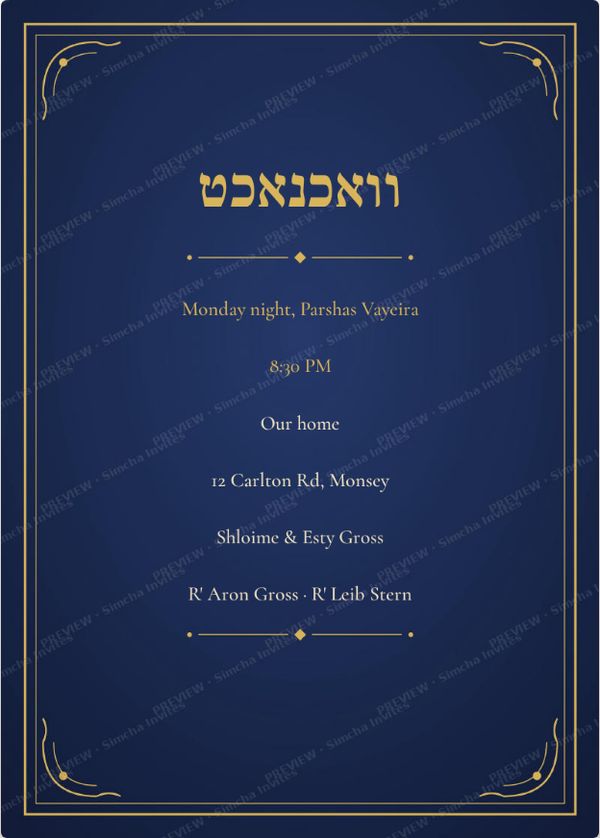
When a shidduch is closed, the l'chaim is often that same night, at the kallah's home. There is no time for a printed card. Families send a short WhatsApp message and make phone calls within an hour or two. A simple picture with the names and the address is a bonus.
Vort
A vort is a larger gathering, held anywhere from a few days to a few weeks after the engagement. Invitations commonly go out a few days to a week ahead. Some families have a vort a day or two after the l'chaim, so a quick invitation is common here too. See our vort and l'chaim wording guide.
Tenoyim
In many chassidish families, tenoyim are written at the engagement itself; in other families they are written at the vort, or before the chuppah. The tenoyim invitation goes out together with the l'chaim or vort notice. For wording, see our tenoyim wording guide, and for cards, our Tenoyim designs.
Chasuna
For printed wedding invitations, about four to six weeks ahead is common. Families with many out-of-town guests, or guests flying from abroad, often tell them earlier by phone or WhatsApp, so they can plan travel. Heimish engagements are often short, so sometimes the cards go out closer to the date; what matters is that guests have enough time to arrange babysitters, travel and a place to stay. Many families also send a WhatsApp copy of the card on the same day the printed cards go out.
Bavarfen / Aufruf
The bavarfen (the chassidish name) or aufruf is commonly on the Shabbos before the chasuna, when the chosson is called to the Torah; customs differ. Invitations commonly go out about one to two weeks ahead, and many families include a line about it with the chasuna card. Since it is on Shabbos, a reminder must go out by Friday. See our bavarfen wording guide.
Sheva Brachos
The sheva brachos are the seven days of celebration after the chasuna. Usually the family arranges the hosts before the chasuna and shares a schedule card listing each night, the host and the address. Each host then sends their own invitation a few days before their night, and a reminder on the day. See our sheva brachos wording guide.
Bar mitzvah, bas mitzvah, upsherin and siyum
Bar Mitzvah
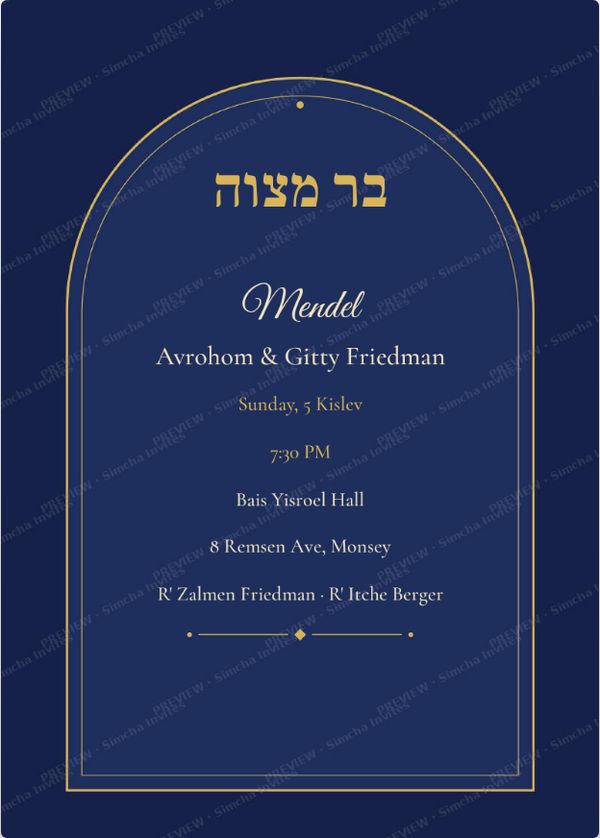
A bar mitzvah is on the boy's 13th birthday by the Hebrew calendar, so the date is known years ahead. Invitations commonly go out about three to six weeks before. For a big seudah with guests from out of town, closer to six weeks; for a smaller kiddush or seudah, three weeks is plenty. Many families send a reminder the day before. See our bar mitzvah wording guide.
Bas Mitzvah
Many heimish families mark a bas mitzvah modestly, with a small family seudah, a kiddush or a celebration in school; some don't make a public celebration at all. When there is an invitation, about two to three weeks ahead is common.
Upsherin
An upsherin is commonly held around a boy's third birthday; some families make it on Lag BaOmer, some in Meron. For a home or shul upsherin, about one to three weeks ahead is common. For a Lag BaOmer upsherin in Meron, guests need much more notice to plan the trip.
Siyum
A siyum is made when a masechta or sefer is finished, so the exact day is known only near the end. Invitations usually go out a few days to a week ahead. A siyum on Erev Pesach for the firstborn is usually announced in shul.
Shabbos and Yom Tov considerations
- Send before candle lighting, with time to spare. A Friday-night sholom zucher or a Shabbos kiddush must be known before Shabbos. Aim for Thursday, or Friday morning at the latest.
- Nothing guests must read on Shabbos. Guests can't check their phones on Shabbos, so all details, the address and any changes must reach them before.
- Watch the time zones. Shabbos starts many hours earlier in Eretz Yisroel and Europe. A message sent Friday afternoon in New York arrives there on Shabbos. Send to guests abroad on Thursday or early Friday.
- Yom Tov means two or three offline days. For a simcha right after Yom Tov, or when Yom Tov is next to Shabbos, send before Yom Tov starts.
- Scheduled messages. If you want to use a phone's "send later" feature, ask your Rav first, and never set it to arrive on Shabbos or Yom Tov.
- Motzei Shabbos simchas. For a melava malka or a Motzei Shabbos vort, send the invitation during the week and a reminder on Friday.
Out-of-town guests
- Tell them first. A phone call or personal message before the general invitation shows respect and gives them time.
- Give extra time. For a chasuna or bar mitzvah, out-of-town guests appreciate hearing as early as the date is final.
- Full address. Write the full street address, with the city, so it can be put into a map. "At our home" means nothing to a guest who has never been there.
- Where to stay. For Shabbos simchas, many families add a line such as "for sleeping arrangements please call ___".
- Time zone in the message. For guests far away, add "New York time" or "Eretz Yisroel time" if there could be confusion.
Planning backwards: a countdown for planned simchas
For a chasuna or a bar mitzvah, it helps to count back from the date. A common schedule:
| Before the simcha | What to do |
|---|---|
| 8–10 weeks | Call or message out-of-town and overseas family so they can plan travel |
| 7–8 weeks | Finalize the wording; check names, parsha and Hebrew date with a luach |
| 6–7 weeks | Make the card, download the PDF for printing and the small JPG for phones |
| 4–6 weeks | Send the printed cards and the WhatsApp copy together |
| 1–2 weeks | Send the bavarfen/aufruf or Shabbos-schedule notice, if there is one |
| 1 week | A gentle reminder to the full list |
| 1 day | A short reminder with the time and address |
For a bar mitzvah the same order works, just shorter: tell far-away family first, send the invitations three to six weeks ahead, and remind the day before.
Timing checklist
- The date is final (for a bris or pidyon haben, confirmed with the mohel, kohen or Rav).
- The Hebrew date and the night-before wording (ליל) are checked in a luach.
- Out-of-town and overseas guests heard early, by phone or personal message.
- Everything goes out before Shabbos and Yom Tov, with room for other time zones.
- A reminder is planned for the day before (Thursday or Friday for a Shabbos simcha).
- If anything changes, a clear "updated" message is ready to send to the whole list.
Jewish-calendar tips for the date line
Timing mistakes on a card often come from the Jewish day, which starts at night.
| On the card | What it means |
|---|---|
| ליל ד' or אור ליום ד' | The night belonging to Wednesday, which is Tuesday night |
| ליל שב"ק | Friday night |
| מוצאי שב"ק / מוצש"ק | Saturday night, after Shabbos |
| יום ה' פרשת ___ | Thursday of the week of parsha ___ |
| בשעה טובה ומוצלחת | "At a good and successful hour", often abbreviated בשעטו"מ |
| לפ"ק | After the year, "by the small count" (without the thousands) |
- The night belongs to the next day. A Tuesday-evening vachnacht is written as the night of Wednesday (ליל ד'), and the Hebrew date of a Tuesday night is already Wednesday's date. Check both against a luach.
- The week is named by its parsha. Sunday to Shabbos is named after the parsha read that Shabbos. Before Yom Tov or in a double-parsha week, check carefully.
- The day of a bris counts from birth. A baby born after sunset counts as born on the next day, which can move the bris by a day. Ask your Rav when a birth is close to sunset.
- Write the English date too for guests who don't use a Jewish calendar every day.
- This year is תשפ"ז (5787). Many cards write שנת תשפ"ז לפ"ק.
More abbreviations are in our Yiddish and Hebrew abbreviations guide.
Reminders
When invitations go out weeks ahead, a reminder helps a lot. Common practice:
- Day before for most evening simchas, or the morning of for a same-night event.
- Thursday or Friday morning for a Friday-night or Shabbos simcha.
- A week before plus the day before for a chasuna or a big bar mitzvah.
- No reminder needed for a sholom zucher, bris or l'chaim; the invitation is already short notice.
Sample timing messages
Short messages for different moments. Copy, fill in and send with the invitation picture.
Same-night l'chaim (Yiddish)
מזל טוב! מיר זענען זיך משמח מיט דער פארלאבונג
פון אונזער טאכטער ___ תחי'
מיט ___ נ"י
לחיים היינט ביינאכט פון 10:00
ביי ___ (address)
Sholom Zucher, sent Thursday (Hebrew)
בשבח והודי' להשי"ת
השלום זכר לרגל הולדת בננו נ"י
יתקיים אי"ה ליל שב"ק פרשת ___
משעה 9:00 בבית ___
מזל טוב!
Bris with short notice (English)
Mazel tov! The Bris of our son will IY"H take place tomorrow, Wednesday, right after Shachris (7:30 AM) at ___. The Vachnacht is tonight at 7:30 PM at our home, ___. We would be honored to have you.
Early notice for out-of-town family (English)
Postponed or changed (Hebrew)
הברית מילה של בננו נ"י נדחתה
ותתקיים אי"ה ביום ___ בשעה ___
ב___
נא לשים לב לזמן החדש
Reminder before Shabbos (Yiddish)
דעם שבת קודש פרשת ___ איז דער קידושא רבא
נאכן דאווענען אין ___
מיר ווארטן אייך!
For how to send these by WhatsApp, text or to a flip phone, see our guide to sending simcha invitations on WhatsApp or by text.

Short notice? Make it in minutes
For the simchas that come suddenly, speed matters more than anything. On our site you can make an invitation in a few minutes and send it the same hour:
- Choose a design: Baby Boy (Sholom Zucher, Vachnacht, Pidyon Haben), Kiddush, Tenoyim, Bar Mitzvah, Bavarfen, Sheva Brachos or Others (Siyum).
- Type your text in each box, in Hebrew, Yiddish or English; adjust the font and size with A− and A+.
- Check the live preview.
- Order and pay ($15).
- Download the PDF, the full-quality JPG and the small texting JPG, and send right away.
Each design has a fixed heading, such as שלום זכר or שבע ברכות. We don't have chasuna, bris, upsherin or bas mitzvah designs yet; our wording guides for those simchas still help with the text.
Common timing mistakes
- Wrong evening. Writing Tuesday's date for a Tuesday-night simcha; at night the Hebrew date has already moved forward.
- Too late before Shabbos. A Friday-afternoon message that guests see only after candle lighting, or that reaches Eretz Yisroel on Shabbos.
- Too early for a short-notice simcha. Announcing a bris before the date is confirmed, then having to correct it.
- Not enough time for travel. Out-of-town guests hearing about a chasuna or bar mitzvah only a week or two before.
- No reminder for an early invitation. Cards sent six weeks ahead are easy to forget.
- Unclear updates. A changed time sent without a clear "updated" line.
Frequently asked questions
How far ahead should I send chasuna invitations?
Commonly about four to six weeks ahead for printed cards, earlier for guests who must travel far. Many families also send a WhatsApp copy the same day.
How far ahead should I send bar mitzvah invitations?
Commonly about three to six weeks before. Closer to six weeks for a big seudah with out-of-town guests, about three weeks for a smaller kiddush or seudah.
When do I send a sholom zucher invitation?
As soon as the baby is born, so that it reaches everyone by Friday, well before candle lighting. A WhatsApp picture and a notice in shul are normal.
Why are bris invitations sent so late?
A bris is usually on the eighth day, but only when the baby is healthy, so the date is confirmed close to the time. Most families send one to three days ahead.
When is a pidyon haben, and when should I invite?
When it applies, on the 31st day after birth, but not on Shabbos or Yom Tov; your Rav sets the day. Since the date is known early, about one to two weeks of notice is common.
Is it fine to invite to a l'chaim the same night?
Yes. A l'chaim is often the same night as the engagement, so a WhatsApp message and phone calls within hours are normal.
When should sheva brachos invitations go out?
The family usually shares a schedule of the seven nights before the chasuna, and each host sends their own invitation a few days before their night.
Can I send an invitation on Friday?
Yes, early enough that every guest sees it before candle lighting. For guests in Eretz Yisroel or Europe, send on Thursday or Friday morning because Shabbos starts there earlier.
How do I write a Tuesday-night simcha in Hebrew?
Write it as the night of Wednesday, ליל ד' or אור ליום ד', because in the Jewish calendar the night belongs to the next day. Check the Hebrew date in a luach.
Should I send a reminder?
For invitations sent weeks ahead, yes: commonly the day before, or Thursday or Friday for a Shabbos simcha. A sholom zucher or bris usually needs none.
Are these timing rules halacha?
No. They are common practice and differ by family and community. Where halacha sets the date, such as a bris or pidyon haben, ask your Rav.