Bavarfen Invitation Wording (Yiddish, Hebrew & English)
How to word a bavarfen (באווארפן) invitation for the chosson's Shabbos before the chasuna: sample cards in Yiddish, Hebrew and English, a Shabbos schedule card, a WhatsApp version, a checklist and answers to common questions.
Updated November 8, 2026
What is a bavarfen?
The bavarfen (באווארפן, from the Yiddish "to throw on") is the chassidish name for the Shabbos aufruf before a chasuna. On that Shabbos the chosson is called up to the Torah in shul. After his aliyah, sweets are thrown toward him, as a wish for a sweet life together. The children run to pick them up, and the whole shul sings "mazel tov". After davening there is a kiddush, often a big one, for family, friends and the shul.
In many chassidish communities this is the Shabbos right before the chasuna. In others it is a week or more earlier, for example when the chasuna is in another city or the chosson's family lives far away. Some families also hold a gathering for the chosson on Friday night (often called a פארשפיל, forshpiel). Customs differ from family to family and from shul to shul, so ask your family and your Rav what is done in your circle.
Outside chassidish circles the same Shabbos is usually called the aufruf or oifruf. The idea is the same: the chosson's aliyah, the sweets, the kiddush. If your family says "aufruf", our aufruf invitation wording guide has wording in that style. This guide is for families who say bavarfen and want the card to sound the way a heimish chassidish card sounds.
Who sends the bavarfen invitation?
The bavarfen is the chosson's simcha, so the invitation usually comes from the chosson's parents. The kallah's family are guests that Shabbos (in many families they come for the kiddush, and some make their own gathering for the kallah that Shabbos). Common ways to sign the card:
- The chosson's parents alone: the most common.
- The parents and grandparents: when the grandparents are in the same shul or are hosting the kiddush.
- The parents together with the shul: when the father is a long-time member, the shul's gabbaim or הנהלת ביהמ"ד sometimes join in the invitation and the kiddush is held in the shul's hall.
- Grandparents as hosts: when the chosson's parents live out of town, the bavarfen is sometimes in the grandparents' shul, and the card says so.
The kallah is usually named by her father: עב"ג בת הרה"ח ר' ___ שליט"א. Many chassidish families don't print the kallah's own first name on a card that goes to the whole shul; others do. Follow what your family does.
What goes on a bavarfen invitation
- The opening at the top: ב"ה, בס"ד or בעזהשי"ת.
- A line of thanks, for example בשבח והודי' להשי"ת.
- The heading: באווארפן (some write שבת אויפרופן or עלי' לתורה).
- Who is inviting: the chosson's parents (and grandparents, if they join).
- The chosson's name with a title: בננו החתן כמר ___ נ"י.
- The shidduch: עב"ג and the kallah's father's name.
- The Shabbos: שבת קודש פרשת ___ and, if you like, the Hebrew date.
- The shul: its name and full street address.
- The time davening starts, or the time of krias haTorah if guests ask for it.
- The kiddush: where it is (shul hall, home, a neighbor's house) and that it is right after davening.
- Optional: a Friday night forshpiel, a Shabbos afternoon gathering, and the chasuna date.
- The signature line at the bottom.
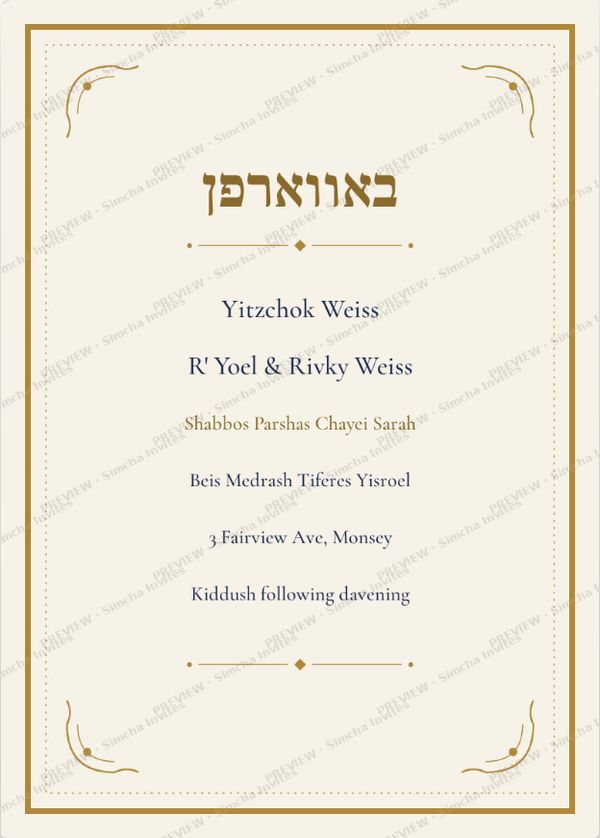
Sample 1: classic Hebrew (lashon kodesh) bavarfen card
This is the style many chassidish families use for the card that goes to the whole shul and family.
בשבח והודי' להשי"ת
הננו מתכבדים להזמין את כבודכם
להשתתף בשמחת הבאווארפן
של בננו החתן המופלג כמר ___ נ"י
עב"ג בת הרה"ח ר' ___ שליט"א
אשר יתקיים אי"ה בשבת קודש פרשת ___
בביהמ"ד ___
___ (address)
הקידוש יתקיים אחר התפלה
בהיכל ___
המצפים לראותכם
___ ומשפחתו
Sample 2: Yiddish bavarfen card
In many homes the bavarfen card is written in Yiddish, because it goes to the neighbors and the whole shul, and it feels warmer.
מיט גרויס פרייד און דאנק צום אייבערשטן
לאדענען מיר אייך הערצליך איין
צום באווארפן
פון אונזער זון דער חתן ___ נ"י
עב"ג בת הרה"ח ר' ___ שליט"א
שבת קודש פרשת ___
אין ביהמ"ד ___
___ (address)
קידוש גלייך נאכן דאווענען
אין זאל פון ביהמ"ד
מיר ווארטן אייך מיט פרייד
___ און משפחה
Sample 3: English bavarfen card
For relatives, neighbors and business friends who don't read Hebrew, a short English card says the same thing in plain words.
With thanks to Hashem
we invite you to the
Bavarfen
of our son, the Chosson ___
Shabbos Parshas ___
at ___ (shul)
___ (address)
Kiddush right after davening
in the shul hall
___ and ___ ___
Sample 4: bavarfen with the grandparents and the shul
When the grandfather is the Rov or a long-time member, or when the kiddush is hosted by the shul, the card can name everyone who is inviting. Keep the names in order: grandparents, then parents.
ברוב שבח והודי' להשי"ת
הננו מתכבדים להזמין את כל קרובינו, ידידינו ומכירינו
להשתתף בשמחת הבאווארפן
של נכדנו ובננו החתן כמר ___ נ"י
עב"ג בת הרה"ח ר' ___ שליט"א מעיה"ק ___
בשבת קודש פרשת ___ תשפ"ז לפ"ק
בביהמ"ד ___
הקידוש יתקיים אי"ה אחר התפלה בהיכל ביהמ"ד
הזקנים: הרה"ח ר' ___ שליט"א
ההורים: הרה"ח ר' ___ הי"ו
וגבאי ביהמ"ד ___
Sample 5: bilingual card (Yiddish on top, English below)
One card for everyone: the Yiddish or Hebrew block on top, and a short English summary under it with only the facts a guest needs.
באווארפן
פון אונזער זון דער חתן ___ נ"י
שבת קודש פרשת ___
אין ביהמ"ד ___ · קידוש נאכן דאווענען
Shabbos Parshas ___
___ (shul), ___ (address)
Kiddush after davening
___ and ___ ___
Sample 6: short Hebrew card for a small bavarfen
Not every bavarfen is a big event. A family that is making only a small kiddush, or a chosson who is called up in his yeshiva or a small shteibel, can send a very short card.
באווארפן
החתן ___ נ"י
שב"ק פרשת ___
בביהמ"ד ___
קידוש אחר התפלה
מזל טוב!
The Shabbos schedule card
Many families have more than one event that Shabbos: a forshpiel on Friday night, the bavarfen and kiddush in the morning, and sometimes something in the afternoon. Out-of-town relatives and mechutonim who come for Shabbos need all of it in one place, and they can't check WhatsApp once Shabbos starts. A Shabbos schedule card solves this. Send it during the week, and print a few copies for the guests' rooms.
Only list the events your family actually makes. Here is a template with every line that families commonly use; delete what you don't need.
| When | What | Where |
|---|---|---|
| Friday, candle lighting ___ | Mincha / Kabbolas Shabbos | ___ (shul) |
| Friday night ___ | Forshpiel (פארשפיל) for the chosson | ___ (home or hall) |
| Shabbos morning ___ | Shachris; the chosson is called up (bavarfen) | ___ (shul) |
| After davening | Kiddush | ___ (shul hall) |
| Shabbos afternoon ___ | Mincha, then sholosh seudos / tish if made | ___ |
| Motzei Shabbos ___ | Maariv, havdalah, melave malka if made | ___ |
The same schedule as a Yiddish card:
סדר השבת
לכבוד הבאווארפן פון אונזער זון דער חתן ___ נ"י
שבת קודש פרשת ___
ליל שב"ק: פארשפיל אום ___ אזייגער, ביי ___
שב"ק אינדערפרי: שחרית אום ___ אזייגער, אין ביהמ"ד ___
קידוש גלייך נאכן דאווענען, אין זאל
שב"ק נאכמיטאג: מנחה אום ___
מיר ווארטן אייך מיט פרייד
___ און משפחה
A schedule card is usually a simple text card or a printed page for the guests. Our Bavarfen design carries the heading באווארפן, so it fits the main invitation best; for the schedule, a short WhatsApp message or a printed sheet works well.
The kiddush: what to write
The kiddush is the part guests most need to know about, because it decides where they go after davening. Say three things clearly:
- Where. "In the shul hall", "in the Beis Medrash downstairs", or a home address. If the kiddush is not in the same building as the shul, write the full address.
- When. Usually אחר התפלה / "right after davening". If there is a gap (for example, the kiddush is at home after a long walk), say so.
- For whom. Most bavarfen kiddushim are open to the whole shul. If yours is for family and invited guests only, the card can say לקרובים ולידידים or "for family and friends", and you may want to send it privately rather than to the shul group.
Some families add a line about the kiddush menu ("kugel, cholent and l'chaim"), but most don't. Food details are not needed on the card.
Line by line: phrases on a bavarfen card
| Phrase | Meaning | Where it goes |
|---|---|---|
| בשבח והודי' להשי"ת | With praise and thanks to Hashem | Opening line |
| הננו מתכבדים להזמין | We are honored to invite | Before the event name |
| בשמחת הבאווארפן | To the simcha of the bavarfen | The main line |
| החתן כמר ___ נ"י | The chosson, Mr. ___, may his light shine | After "our son" |
| המופלג בתוי"ש | Outstanding in Torah and fear of Heaven | Optional title before the name |
| עב"ג (עם בת גילו) | With his chosen match | Before the kallah's family |
| שב"ק (שבת קודש) | The holy Shabbos | Before the parsha |
| הקידוש יתקיים אחר התפלה | The kiddush will be after davening | The kiddush line |
| המצפים לראותכם | Who look forward to seeing you | Above the signature |
| לפ"ק | "By the small count" (year without the thousands) | After the year, e.g. תשפ"ז לפ"ק |
For more abbreviations and what they mean, see our guide to Yiddish and Hebrew invitation abbreviations.
Choosing the title for the chosson and the fathers
Titles are where families feel the most. A few common choices:
- For the chosson: כמר ___ נ"י is the plain, standard one. החתן המופלג or המופלג בתוי"ש are often added for a bochur from yeshiva. Some write החתן הבחור המצוין. Keep it to one title; a long list looks crowded.
- For the kallah's father: הרה"ח ר' ___ שליט"א or הי"ו. If he is a Rov or a Rosh Yeshiva, use the title he is known by.
- Hometown: when the kallah's family is from another city, many cards add מעיר ___ or מעיה"ק ___ (for Yerushalayim or another holy city).
When in doubt, look at the last card your family sent for a brother's or cousin's bavarfen, and match it. Guests notice when two cards from the same family use different titles.
Bavarfen on the chasuna card, or a separate card?
Families do it both ways:
- A line on the chasuna invitation. Some add one line at the bottom of the chasuna card: הבאווארפן יתקיים אי"ה בשב"ק פרשת ___ בביהמ"ד ___. This works when the same guests are invited to both.
- A separate card. More common when the bavarfen is in the chosson's own shul and the whole shul is invited, while the chasuna list is different. A separate card also lets you add the kiddush and the Shabbos schedule.
- Both. One line on the chasuna card for out-of-town family, and a separate card for the shul and neighbors.
For wording of the chasuna card itself, see our chasuna invitation wording guide.
Making a bavarfen card on our site, step by step
Our Bavarfen category has a ready design with the heading באווארפן. Here is how to make yours:
- Open the Bavarfen designs and tap the design.
- The card shows on top, with a text box for each part underneath. Type your details into each box: the parents, the chosson's name, the parsha, the shul, the kiddush. You can type in Yiddish, Hebrew, English or a mix.
- Watch the live preview. Every line updates as you type, so you see exactly where it falls.
- Pick a font for each text box, and use A− and A+ to make a line smaller or bigger. A long name may need A−; the chosson's name often looks best a little bigger. Tap Reset to go back to the design's size.
- Tap a line of text on the card to jump to its box.
- Check the preview on your phone, because that is where most guests will see it. Before you pay, the preview carries a watermark.
- Place the order and pay ($15).
- Download your three files: a print PDF, a "Full quality – for printing" JPG (2550 px wide, 300 dpi), and a "Small – for texting (MMS), under 1 MB" JPG for WhatsApp, text messages and email.
The heading באווארפן is part of the design and can't be changed. If your family calls it an aufruf and wants that word as the heading, this design is not the right fit; the text boxes are for your details.
The WhatsApp version
Most guests will get the card on WhatsApp. Send the small "for texting" JPG with a short message, so people who don't open pictures still have the facts. Keep it to three or four lines.
מיר זענען זיך משמח מיט'ן באווארפן פון אונזער זון דער חתן ___ נ"י
שב"ק פרשת ___ אין ביהמ"ד ___
קידוש נאכן דאווענען
מזל טוב!
הנכם מוזמנים לבאווארפן של בננו החתן ___ נ"י
שב"ק פרשת ___ בביהמ"ד ___
קידוש אחר התפלה
You're invited to the Bavarfen of our son ___
Shabbos Parshas ___ at ___ (shul)
Kiddush right after davening
Mazel tov!
Send it early in the week, and a short reminder on Thursday or Friday morning, well before candle lighting. Once Shabbos starts, nobody can check their phone for the address, so every detail must be clear before then. Our guide on sending simcha invitations on WhatsApp or by text explains which file to send to whom, including people with kosher flip phones.
When to send the bavarfen invitation
A common pattern is to send the bavarfen card about one to two weeks before that Shabbos, often right after or together with the chasuna invitations. The shul and neighbors can get it a few days before. Out-of-town relatives who are coming for Shabbos need it earlier, so they can book where to stay. These are common practices, not rules. For a full timing table for every simcha, see our guide to when to send simcha invitations.
Common mistakes
- Writing the wrong parsha. Check the parsha in a luach. In some years two parshiyos are read together, and in Eretz Yisroel the parsha can differ from chutz la'aretz for a few weeks after Yom Tov. Write it the way your shul reads it that week.
- Leaving out the shul address. Guests from other neighborhoods have to know where to walk on Shabbos. "Our shul" is not enough.
- Not saying where the kiddush is. If it is in another building, guests will wait in the wrong place.
- Forgetting the walking distance. If guests are coming from far, they need to plan where to stay for Shabbos. Tell them early, or add a contact line for hosting.
- Sending on Friday afternoon. A card that arrives an hour before candle lighting is easy to miss. Send it during the week.
- Too many lines. A bavarfen card needs the simcha, the chosson, the Shabbos, the shul and the kiddush. Save the rest for the schedule card.
- Mixing languages line by line. Keep the Yiddish or Hebrew block together and the English block together.
Checklist before you send
- Chosson's name spelled the way the family writes it, in Hebrew letters and in English.
- Kallah's father's name and title checked with the mechutonim.
- Parsha (and date, if you write it) checked against a luach.
- Shul name and full address.
- Davening time, if you include it.
- Kiddush place and "after davening".
- Signature: who is inviting, in the order your family uses.
- Friday night or afternoon events, only if you make them.
- A look at the card on your own phone before sending.
- Sent early in the week, with a reminder before Shabbos.
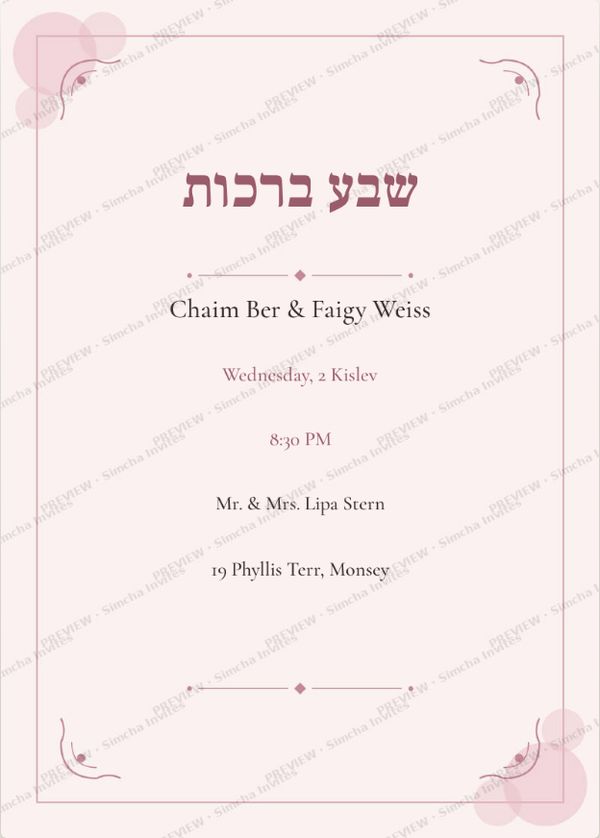
The other simchas around the chasuna
The bavarfen is one of several events in the weeks around a chasuna. If you are making cards for the others, these guides may help:
- Before the engagement is public: the l'chaim and the vort, in our vort and l'chaim wording guide.
- The tenoyim: wording, both sides or one side, in our tenoyim invitation wording guide, with ready Tenoyim designs.
- The week after the chasuna: sheva brachos wording with a per-night schedule, and our Sheva Brachos designs.
Frequently asked questions
What does bavarfen mean?
Bavarfen (באווארפן) is Yiddish for "throwing on". It is the chassidish name for the Shabbos before the chasuna when the chosson is called up to the Torah and sweets are thrown toward him as a wish for a sweet life.
Is a bavarfen the same as an aufruf?
Yes, it is the same Shabbos with a different name. Chassidish families usually say bavarfen; many yeshivish and other families say aufruf or oifruf. Our aufruf wording guide has wording in that style.
Who sends the bavarfen invitation?
Usually the chosson's parents, since it is the chosson who is called up. Grandparents or the shul sometimes join in the invitation, especially when the kiddush is in the shul hall.
Which Shabbos is the bavarfen?
In many communities it is the Shabbos right before the chasuna, but some families hold it a week or more earlier. Customs differ, so follow your family and ask your Rav.
Should the kallah's name be on the card?
Many chassidish cards name only the kallah's father, as עב"ג בת הרה"ח ר' ___. Other families print her name too. Follow what your family has done on earlier cards.
Do I need to write the time of davening?
It is helpful, especially for guests from other shuls. Some families also write the approximate time of krias haTorah, so guests know when the chosson will be called up.
Is the kiddush open to everyone?
Most bavarfen kiddushim are open to the whole shul. If yours is only for invited family and friends, say so gently on the card, for example "for family and friends", and send it privately.
Can I put the bavarfen on the chasuna invitation?
Yes. Many families add one line at the bottom of the chasuna card with the parsha and the shul. A separate card is better when the whole shul is invited or you want to include the kiddush and a Shabbos schedule.
When should I send the bavarfen card?
Commonly one to two weeks before, with a reminder on Thursday or Friday morning. Out-of-town guests coming for Shabbos need it earlier. See our timing guide.
Can I change the heading on your Bavarfen design?
No. The heading באווארפן is fixed on the design. You type everything else: names, parsha, shul and kiddush. If you want a different heading, this design is not the right one.
What files do I get, and which do I send on WhatsApp?
After paying $15 you get a print PDF, a full-quality JPG (2550 px wide, 300 dpi) and a small JPG under 1 MB made for WhatsApp, text messages and email. Send the small JPG on phones and print from the PDF.
Can I write the card in Yiddish and English together?
Yes. You can type Yiddish, Hebrew, English or a mix in each text box. A clean way is the Yiddish or Hebrew block on top and a short English summary below.
Make your bavarfen card
Pick the Bavarfen design, type your family's wording from the samples above, choose a font and size for each line, and download your print PDF and texting JPG for $15. Mazel tov to the chosson and the whole family.