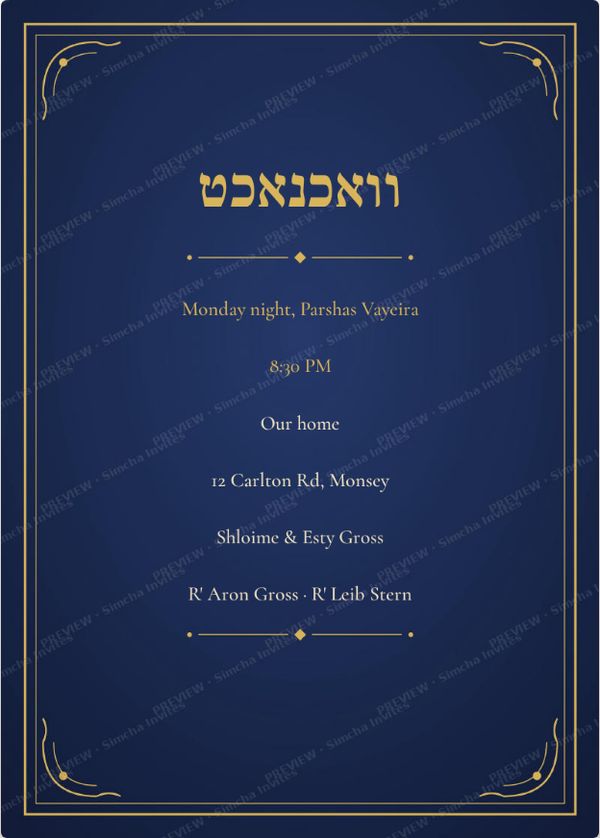
A vachnacht (וואכנאכט, "the night of watching") is the gathering on the night before a bris. Family and friends come to the home of the newborn boy, children say Krias Shema beside the baby, and there is usually something sweet to eat. Because a bris is often on day eight, the vachnacht invitation is usually made in a hurry, sometimes together with the bris invitation. This guide gives you the usual wording in Hebrew, Yiddish and English, and a checklist so nothing is missed.
What a vachnacht invitation includes
- A heading: וואכנאכט (some call it ליל שמירה).
- The opening line of thanks, for example ברוב שבח והודאה להשי"ת.
- Who is inviting: the parents, sometimes with the grandparents.
- The occasion: the birth of a son, למז"ט.
- The day (often with the parsha), the Hebrew date and the time.
- The place, usually the parents' home or a grandparent's home, with the full address.
- Optionally, the time and place of the bris the next morning.
Sample wording in Hebrew / lashon kodesh
ברוב שבח והודאה להשי"ת הננו מתכבדים להזמין
את כל קרובינו ידידינו ומכירינו להשתתף
בשמחת הוואכנאכט
לרגל הולדת בננו למז"ט
שתתקיים אי"ה ביום ___ פרשת ___
בשעה ___ בערב
בבית ___
___ (address)
המצפים לקבל פניכם בשמחה
___ ומשפחתו
Sample wording in Yiddish
מיט גרויס דאנק צום אייבערשטן
לאדענען מיר איין אלע קרובים און פריינט
צו דער וואכנאכט
לרגל דער געבורט פון אונזער זון למז"ט
וואס וועט זיין אי"ה ___
ביי ___
___ (address)
מיר ווארטן אייך מיט פרייד
Sample wording in English
"With gratitude to Hashem, we invite our family and friends to the Vachnacht for our newborn son, Tuesday evening, Parshas ___, at 8:00 PM, at our home, ___. The Bris will take place, b'ezras Hashem, Wednesday morning at ___."
Adding the bris on the same card
Many families put the vachnacht and the bris on one card. A clean way is two short blocks: the vachnacht line first (evening, at home), then a line beginning והברית מילה תתקיים אי"ה with the time and shul. Keep each block to the same pattern (day, time, place, address) so guests can read it in one glance.
Common mistakes
- Wrong evening. The vachnacht is the night before the bris. If the bris moves (for example, for the baby's health), update the date on both.
- Missing address. Guests from out of town need a full street address, not only "at our home".
- Too many names. Parents and grandparents are usual; a long list of great-grandparents makes the card crowded.
- Leaving out the time. Even if "everyone knows", write the hour.
Checklist before you send
- Names spelled the way the family spells them, in Hebrew letters and in English.
- Parsha and Hebrew date checked against a luach.
- Time and address correct.
- Bris time and place correct, if included.
- One more look at the preview on your phone, because that is where most guests will see it.
Hebrew and English on one card
Many families send one card in Hebrew or Yiddish and a second in English for relatives and neighbors who don't read Hebrew. If you put both on one card, keep the Hebrew on top and the English as a short summary underneath: the simcha, the day, the time and the address. Names in English should be spelled the way the family spells them in daily life, which is often different from a word-for-word transliteration.
Sending it
Most guests now receive simcha invitations on WhatsApp. Send the small texting JPG to family groups first, then to the shul group, and print one copy for the shul notice board. If the details change, send the corrected card with a short line such as "updated time", so nobody keeps the old one.
JPG or PDF: which file do you need?
After you pay you get three files, each for a different job. The Small – for texting JPG is under 1 MB, so it goes through on WhatsApp and on picture messages (MMS) without turning blurry; many phone carriers limit picture messages to about that size. The Full quality JPG is 2550 px wide at 300 dpi, sharp enough to print at home. The PDF is print-ready at letter size and holds one flat image, so the print looks exactly like the preview. If you only send the card on phones, the small JPG is all you need; if you are going to a printer, bring the PDF.
| Use | Best file | Why |
|---|---|---|
| WhatsApp, text message (MMS) | Small JPG for texting | Under 1 MB, opens fast, stays sharp |
| Small JPG (or the PDF) | Small file, opens on any phone | |
| Print a few copies at home | Full quality JPG or PDF | 300 dpi, prints sharp |
| Printer or copy shop | Exact letter page size | |
| Shul notice board | Print once, pin it up | |
| Animated card (designs that have one) | GIF or small GIF | Moves when it opens on a phone |
Making your invitation on a phone, step by step
- Open the site and tap your simcha, for example Sholom Zucher or Tenoyim.
- Tap the design you like. The card appears on top, the form underneath.
- Type the details. The card updates as you type, so you can see exactly where each line falls.
- Tap the order button under the card, then pay.
- After paying, download your three files: the PDF, the full-quality JPG and the small JPG for texting.
Make it now
On MazelTovInvite the vachnacht design asks only for these fields: day or parsha, time, place, address, parents and grandparents. The heading וואכנאכט is fixed by the design. Type your details, check the live preview and pay $15 and download a print PDF, a full-quality JPG and a small JPG for texting.
More sample wording in lashon kodesh
Here is a fuller version that puts the vachnacht and the bris on the same card, in the style many chassidish families use. The baby is still unnamed, so he is "our son" until the bris.
ברוב שבח והודאה להשי"ת על החסד אשר גמלנו
הננו מתכבדים להזמין את כל קרובינו, ידידינו ומכירינו
להשתתף בשמחת הוואכנאכט
לרגל הולדת בננו הרך הנולד למזל טוב
אשר תתקיים אי"ה אור ליום ___ פרשת ___
בשעה ___ בערב, בביתנו ___
והברית מילה תתקיים אי"ה ביום ___ בבוקר
בשעה ___ בביהמ"ד ___
המצפים לקבל פניכם בשמחה
ההורים: ר' ___ הי"ו וזוגתו תחי'
הסבים: הרה"ח ר' ___ הי"ו · הרה"ח ר' ___ הי"ו
A short card, for a family that is sending the bris invitation separately:
וואכנאכט
לרגל הולדת בננו נ"י למז"ט
אור ליום ד' פרשת ___ · בשעה 7:30
בבית ___
___ (address)
קריאת שמע עם הילדים בשעה 7:30
More sample wording in Yiddish
Yiddish is the most common language for a vachnacht card in many chassidish homes, because the evening is so homey. A longer version:
מיט א הארציגן דאנק צום אייבערשטן
לאדענען מיר הערצליך איין אלע קרובים, פריינט און שכנים
צו דער וואכנאכט
לרגל דער געבורט פון אונזער זון שיחי' למז"ט
דינסטאג צו נאכטס, פרשת ___
פון ___ אזייגער
אין אונזער וואוינונג, ___
די ברית מילה וועט זיין אי"ה מיטוואך אינדערפרי
אין ___, אום ___ אזייגער
מיר ווארטן אייך מיט פרייד
___ און משפחה
And a WhatsApp-style message for the cousins' and neighbors' groups:
וואכנאכט ביי אונז היינט ביינאכט
קריאת שמע מיט די קינדער 7:30
___ (address)
מזל טוב!
More sample wording in English
With thanks to Hashem
we invite you to the
Vachnacht
of our newborn son
Tuesday evening, Parshas ___, at 7:30 PM
at our home, ___
Krias Shema with the children at 7:30
The Bris will take place, b'ezras Hashem,
Wednesday morning at ___ AM at ___
___ and ___ ___
Line by line: what each phrase means
- ב"ה / בס"ד / בעזהשי"ת — the opening at the top. Any one of them is correct; most families have a habit and keep it on every card.
- ברוב שבח והודאה להשי"ת — "with much praise and thanks to Hashem", the thanks for the birth.
- הננו מתכבדים להזמין — "we are honored to invite", the formal opening. On a short card you can leave it out.
- בשמחת הוואכנאכט — "to the simcha of the vachnacht". Some families write ליל שמירה or ליל הוואכנאכט instead; the meaning is the same.
- לרגל הולדת בננו — "on the occasion of the birth of our son". Add בכורנו if he is the firstborn.
- אשר תתקיים אי"ה — "which will take place, im yirtzeh Hashem". Vachnacht is treated here as feminine (the שמחה), so תתקיים is natural.
- אור ליום ___ — literally "the light of day ___", the classic way to write "the night before". אור ליום ד' means Tuesday night, the night that belongs to Wednesday. This is the most precise wording for a vachnacht.
- קריאת שמע — the children saying Shema near the baby. Many families write the time for it, because parents bring small children only for that part.
- והברית מילה תתקיים אי"ה — "and the bris will take place", the start of the bris block.
- המצפים לקבל פניכם בשמחה — "who look forward to greeting you with joy", the line before the names.
"The night before": writing the day correctly
A vachnacht is the night before the bris, and in Jewish counting that night already belongs to the bris day. That is why a good card names the night by the bris day, not by the evening's weekday. There are three common ways to do it:
| Wording | Meaning | When to use |
|---|---|---|
| אור ליום ד' | The night before Wednesday (Tuesday night) | Lashon kodesh cards; the most exact |
| ליל ד' פרשת ___ | The night of Wednesday by Jewish counting, i.e. Tuesday evening | Also common; some guests find it confusing, so add the hour |
| ביום ג' בערב | Tuesday evening | Simple and clear for everyone |
| דינסטאג צו נאכטס | Tuesday night (Yiddish) | Yiddish cards |
| Tuesday evening | English | English cards; always the evening's own weekday |
Because the two systems can confuse people, many families write the evening's weekday in plain words and add the parsha, and they leave the "אור ליום" style for the more formal card. Either way, the hour removes all doubt. The days of the week are written with letters: א' Sunday, ב' Monday, ג' Tuesday, ד' Wednesday, ה' Thursday, ו' Friday, and שב"ק for Shabbos.
Time wording
Most vachnachts are early in the evening, because small children come to say Krias Shema and then go to bed. Many families do Krias Shema first, at a set time, and keep the house open for adults for an hour or two afterwards. Common time lines:
- בשעה 7:30 בערב — at 7:30 in the evening.
- קריאת שמע בשעה 7:00, ולאחר מכן כיבוד קל — Krias Shema at 7:00, then light refreshments.
- פון 8:00 ביז 10:00 — from 8 to 10 (Yiddish).
- נאך מעריב — after maariv, for a family that davens in a nearby shul.
In the winter, when it is dark early, 6:30 or 7:00 is common. In the summer some families start a little later. Write whatever fits your home and your children's bedtime, and write PM on the English card.
Titles and honorifics on a vachnacht card
The same titles are used on all baby-boy cards. A short guide:
| Title | Full form | Used for |
|---|---|---|
| נ"י | נרו יאיר | The baby ("בננו נ"י") and other young boys |
| שיחי' | שיחיה | The baby or another living man or boy |
| ר' | רבי | Before an adult man's name |
| הרה"ח | הרב החסיד | Before the name of a father or grandfather, in chassidish style |
| מו"ה | מורנו הרב | Before a man's name, often with ר' |
| הי"ו | ה' ישמרהו ויחייהו | After a living adult man's name |
| שליט"א | שיחיה לאורך ימים טובים אמן | After a Rav's or Rebbe's name; some use it for an older grandfather |
| תחי' | תחיה | After a woman's name: וזוגתו תחי' |
Keep the titles the same as on the bris card, and the same as at the family's last simcha. If you are not sure how a grandfather is usually written, look at an old family invitation or simply ask him.
The grandparents' lines
Many vachnacht cards list only the parents, because the bris card will carry the full family. If you do add the grandparents, a short line is enough:
הסבים: הרה"ח ר' ___ הי"ו · הרה"ח ר' ___ הי"ו
When the vachnacht is at the grandparents' home, write it as their invitation, or write בבית הורינו / בבית זקני התינוק with the address. Guests need to know which house.
Special situations
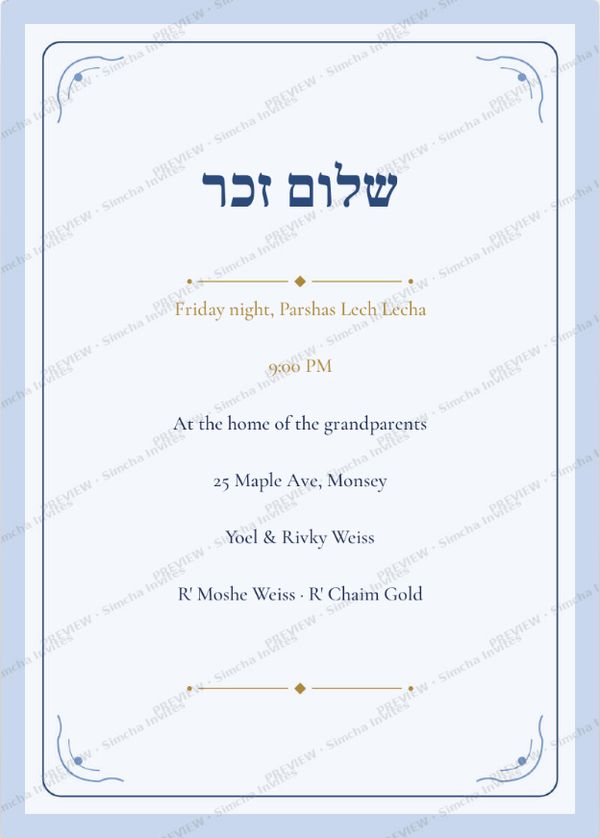
- A bris on Shabbos. When the bris is on Shabbos, the vachnacht falls on Friday night, often the same night as the sholom zucher. Many families then hold one gathering and write both headings on the card, one under the other: שלום זכר and וואכנאכט. Follow what your family and kehillah usually do.
- A postponed bris. If the bris is delayed, for example for the baby's health, the vachnacht moves with it to the night before the new date. Don't send the card until the bris date is confirmed.
- Twins. Write לרגל הולדת בנינו התאומים נ"י. If there are two brissin on different days, there are usually two vachnachts too.
- Vachnacht at the grandparents. Common when the mother and baby are staying there after the birth. Write the grandparents' address clearly.
- A bris out of town. If the bris is in another city, guests from your neighborhood may come only to the vachnacht. Make the vachnacht card stand on its own with full details.
More mistakes we see often
- Mixing up the weekday. "ליל ד'" means Tuesday night, not Wednesday night. If you use it, add the hour or write the weekday in plain words.
- Writing the baby's name. The name is given at the bris, so on the vachnacht card he is "our son".
- No Krias Shema time. Parents of small children want to know when to come.
- Copying last week's card. If you reuse the sholom zucher card, change the heading, the day and the time; old details are easy to miss.
- Inconsistent spelling. וואכנאכט is spelled the same way on the whole card, and the names match the bris card.
The full vachnacht card at a glance
| Part of the card | Example | Needed? |
|---|---|---|
| Opening | ב"ה | Usual |
| Heading | וואכנאכט | Yes (built into our designs) |
| Thanks and invitation | ברוב שבח והודאה להשי"ת הננו מתכבדים להזמין | Optional on a short card |
| Reason | לרגל הולדת בננו נ"י למז"ט | Yes |
| Day and parsha | אור ליום ד' פרשת ___ | Yes |
| Time | בשעה 7:30 בערב | Yes |
| Krias Shema | קריאת שמע עם הילדים 7:30 | Nice to have |
| Place and address | בביתנו, 123 Main St | Yes |
| Bris block | והברית מילה תתקיים אי"ה... | If on the same card |
| Parents | ר' ___ הי"ו וזוגתו תחי' | Yes |
| Grandparents | הסבים: ___ | Optional |
Full checklist
- Bris date confirmed with the mohel and, if needed, the doctor.
- Day written clearly: weekday plus parsha, or אור ליום with the hour.
- Krias Shema time, if you want children to come.
- Full address, apartment and entrance.
- Bris time and shul, if on the same card, with the shul's full name.
- Names and titles the same as on the bris card.
- An English line for guests who need it.
- Preview checked on a phone, then the JPG sent to the family groups.
Related guides
- Sholom Zucher invitation wording
- Pidyon Haben invitation wording
- Yiddish & Hebrew invitation abbreviations
Which night is the vachnacht? A day-by-day table
The vachnacht is the night before the bris, so the card's day comes from the bris day. In Hebrew the night belongs to the next day, which is why cards write אור ליום ("the night of") with the bris day. Use this table to write it correctly.
| Bris day | Vachnacht | On the card |
|---|---|---|
| Sunday | Motzei Shabbos | מוצאי שב"ק / אור ליום א' |
| Monday | Sunday night | אור ליום ב' |
| Tuesday | Monday night | אור ליום ג' |
| Wednesday | Tuesday night | אור ליום ד' |
| Thursday | Wednesday night | אור ליום ה' |
| Friday | Thursday night | אור ליום ו' |
| Shabbos | Friday night | ליל שב"ק |
For a Motzei Shabbos vachnacht, send the card before Shabbos and write a time that leaves guests room after havdalah. For a Friday night vachnacht, everything guests need must be in the card before candle lighting. Our guide on when to send simcha invitations has more timing tips.
More complete samples for different situations
Vachnacht and sholom zucher together on Friday night (Yiddish)
When the bris is on Shabbos, the vachnacht falls on Friday night, often together with the sholom zucher. Our designs each have one fixed heading, so write the second name in the text.
מיט דאנק צום אייבערשטן
לאדענען מיר אייך איין צום
שלום זכר און וואכנאכט
לרגל דער געבורט פון אונזער זון נ"י
ליל שב"ק פרשת ______, נאך די סעודה
אין אונזער וואוינונג, ______
די ברית מילה וועט זיין אי"ה שבת קודש
נאכן דאווענען, אין ביהמ"ד ______
At the grandparents' home (lashon kodesh)
הננו מתכבדים להזמינכם להשתתף בשמחת הוואכנאכט
לרגל הולדת בננו נ"י למז"ט
אור ליום ג' פרשת ______ בשעה 8:00
בבית הורינו הרה"ח ר' ______ הי"ו
______ (address)
קריאת שמע עם התשב"ר בשעה 7:30
Twin boys (English)
Please join us for the
Vachnacht
of our twin sons
Sunday night, at 8:00 PM
at our home, ______
Krias Shema with the children at 7:30
The bris will be Monday morning, after Shacharis, at ______
A short notice for the shul or kehilla group
Vachnacht tonight, 7:30–10:00, at ______.
Bris tomorrow after Shacharis, ______ shul.
The bris itself has its own wording; see our bris invitation wording guide for the full sequence from the sholom zucher to the pidyon haben.
Make your vachnacht card on our site, step by step
- Pick the design. Open the Baby Boy designs and tap the one you like. The heading is already part of the picture, so you never type it.
- Type each box. Every box has a label that says what it is for: the day or parsha, the time, the place, the address, the parents and the grandparents. You can type in Hebrew, Yiddish, English or a mix. You can also tap a line on the card to jump straight to its box.
- Choose a font and size. Each box has its own font picker and A− / A+ buttons. If you add a bris block, make it a size smaller than the vachnacht line so the night is clear.
- Check the preview. The card updates as you type. Look at it once at phone size, because that is how most guests will see it. The preview has a watermark; the paid files do not.
- Place the order and pay. The price is $15. On designs that have an animated GIF version, you can add the GIF for a small extra.
- Download your 3 files. Right after paying you get a print PDF (letter size), a Full quality JPG for printing (2550 px wide, 300 dpi) and a Small – for texting JPG under 1 MB for WhatsApp, text messages and email. GIF orders also get the GIF and a small GIF. Save the page so you can download again later.
For how to send the small file to many people at once, see our guide to sending simcha invitations on WhatsApp or by text.
When the bris date moves
Sometimes the bris is pushed off, for example when the doctor or mohel says the baby needs a few more days. Then the vachnacht moves too. Do not send a corrected card as a new picture with no words. Send it with one clear line on top, such as "The bris has been moved. New vachnacht: ______", and ask family to delete the old one. When the new date is not known yet, a short text is better than a card: "The bris is postponed, b'sha'ah tovah. We will let you know." Make the new card only when the date is final.
Frequently asked questions
When is a vachnacht?
On the night before the bris, usually the seventh night after the baby is born, at the parents' or grandparents' home.
Can the vachnacht and bris be on one invitation?
Yes. Many families print one card with the vachnacht in the evening and the bris the next morning, each with its own time and place.
Do children say Krias Shema at the vachnacht?
In many families, yes. Children come in the early evening and say Shema near the baby, which is why many cards write a time for Krias Shema.
What does אור ליום mean on a vachnacht invitation?
It means "the night before" a given day. אור ליום ד' is Tuesday night, the night before a Wednesday bris.
Is the baby's name written on the vachnacht card?
No. The baby is named at the bris the next morning, so the card says "our son" (בננו נ"י).
What if the bris is on Shabbos?
Then the vachnacht is on Friday night, and many families hold it together with the sholom zucher and write both headings on one card.
How do I write a Motzei Shabbos vachnacht?
Write מוצאי שב"ק with the parsha, or אור ליום א', and give a time that leaves guests room after havdalah. Send the card before Shabbos.
Which file do I send to the family groups?
Send the Small – for texting JPG. It is under 1 MB, so it opens quickly on WhatsApp and on picture messages, even on simple phones.
Can our vachnacht design also say sholom zucher?
Each design has one fixed heading. When the two are on the same night, use the Vachnacht or Sholom Zucher design and write the second name in the first text line.
How long does it take to make the card?
A few minutes. You type the details, check the preview, pay $15, and the three files download right away, which helps when the bris is in two days.