Bris Invitation Wording: Sholom Zucher, Vachnacht, Bris & Pidyon Haben
How heimish families invite and announce every step around a baby boy's bris, from the first Friday night to the pidyon haben, with sample wording in Hebrew, Yiddish and English.
Updated November 8, 2026
A bris is a week of simchas, not one event
When a baby boy is born, the family usually has several simchas in a short time. On the first Friday night there is a Sholom Zucher. On the night before the bris there is a Vachnacht. On the eighth day, im yirtzeh Hashem, is the Bris Milah, followed by a seudas mitzvah. And if the baby is a firstborn who needs a Pidyon Haben, there is one more simcha on day 31.
Each one has its own wording and its own way of being announced. This guide walks through all of them in order, so you can see the whole week at once. For each step you will find what goes on the card, complete sample wordings, and the small details that families often get wrong in the rush. Customs differ between kehillos and families; where it matters, we say so, and the final word belongs to your Rav, your mohel and your family.
Honest note: we don't have a bris-titled design yet. Our Baby Boy category has designs for the Sholom Zucher, the Vachnacht and the Pidyon Haben. Each design has a fixed Hebrew heading. Many families put the bris details on the vachnacht card, as shown below.
The order of the simchas
Here is the usual sequence for a healthy baby whose bris is on time. Everything moves if the bris is postponed.
| Simcha | When | Usual place | Card? |
|---|---|---|---|
| Sholom Zucher שלום זכר | The first Friday night after the birth | The parents' or grandparents' home | Often a short card or WhatsApp notice |
| Vachnacht וואכנאכט | The night before the bris | At home | Usually, often together with the bris |
| Bris Milah ברית מילה | Day 8, in the morning | Shul, Beis Medrash or hall | Usually, on short notice |
| Seudas mitzvah סעודת מצוה | Right after the bris | Same place or a hall | A line on the bris card |
| Pidyon Haben פדיון הבן | Day 31, when it applies | Home, hall or shul | Yes, with more notice |
Counting the eighth day: the day of the birth is day one. A boy born on a Tuesday has his bris, if all is well, on the next Tuesday. A boy born on Tuesday night after nightfall is counted as born on Wednesday, so his bris is the next Wednesday. This is why the exact time of birth matters, and why the mohel and the Rav, not the calendar app, confirm the date.
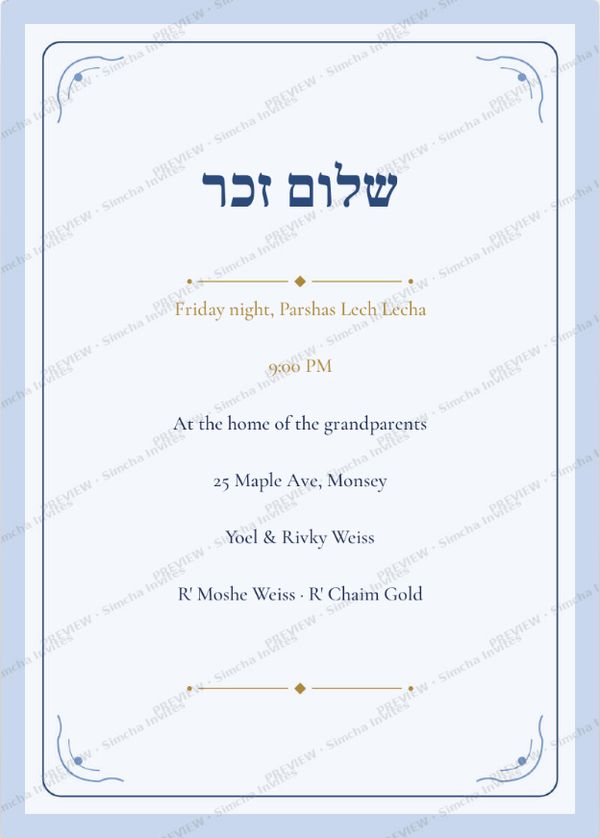
Step 1: the Sholom Zucher
The Sholom Zucher (שלום זכר) is held on the first Friday night after a boy is born. Men and boys come to the house after the seudah to wish mazel tov. There are usually cooked chickpeas (arbes), beer, fruit and cake. Because the baby may be born on a Wednesday or Thursday, this card is often made in a few hours, so short is good.
What goes on a sholom zucher card
- The heading שלום זכר.
- The occasion: the birth of a son, למז"ט.
- Shabbos and the parsha: ליל שב"ק פרשת ___.
- The time, often "after the seudah" or an hour.
- The address.
- The parents' names, and sometimes the grandparents'.
Sample: Hebrew
בשבח והודי' להשי"ת
הננו מתכבדים להזמין את כל קרובינו ומכירינו
לשמחת השלום זכר
לרגל הולדת בננו למז"ט
שיתקיים אי"ה בליל שב"ק פרשת ___
אחר הסעודה, בשעה ___
בביתנו ___
___ ומשפחתו
Sample: Yiddish
מיט גרויס פרייד לאדענען מיר אייך איין
צום שלום זכר
לרגל דער געבורט פון אונזער זון למז"ט
פרייטאג צו נאכטס, פרשת ___
נאך די סעודה
ביי אונז אין דער היים, ___
___ און משפחה
Full details and many more samples are in our Sholom Zucher wording guide.
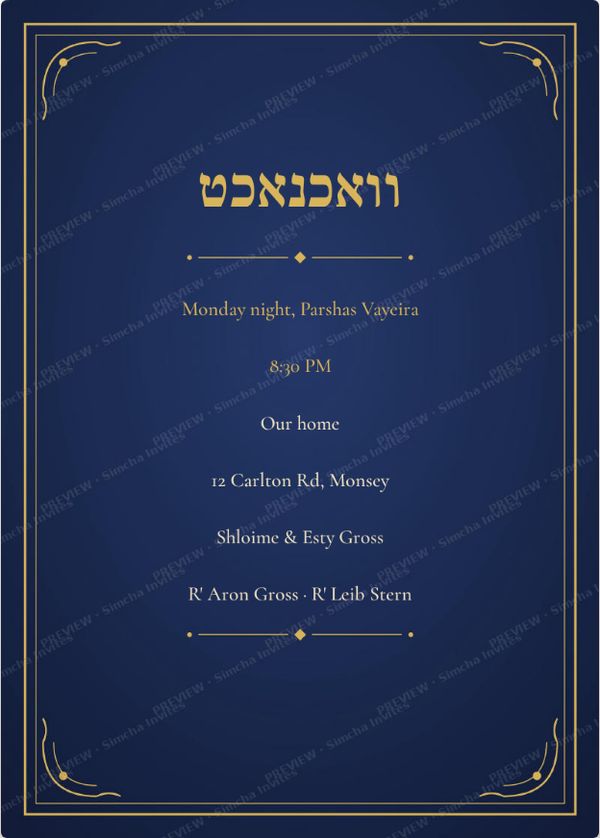
Step 2: the Vachnacht
The Vachnacht (וואכנאכט, "night of watching") is the night before the bris. It is mainly an Ashkenazi and chassidish custom. Children come to say Krias Shema beside the baby, and in many homes men learn or say Tehillim. There is usually something sweet for the children and light refreshments for the adults. Some families call it ליל שמירה.
Because the vachnacht is only a day before the bris, most families announce both at once. The vachnacht part comes first, then a second block for the bris.
Sample: Hebrew, vachnacht with the bris on one card
ברוב שבח והודאה להשי"ת
הננו מתכבדים להזמין את כל קרובינו ידידינו ומכירינו
להשתתף בשמחת הוואכנאכט
לרגל הולדת בננו הרך הנולד למז"ט
אשר תתקיים אי"ה אור ליום ___ פרשת ___
בשעה ___ בערב, בביתנו ___
והברית מילה תתקיים אי"ה ביום ___ בבוקר
אחר תפלת שחרית, בביהמ"ד ___
המצפים לקבל פניכם בשמחה
___ ומשפחתו
Sample: Yiddish
מיר לאדענען אייך הערצליך איין
צו דער וואכנאכט
פון אונזער זון שיחי' למז"ט
היינט ביינאכט, ___ אזייגער
קריאת שמע מיט די קינדער ___ אזייגער
ביי אונז, ___
די ברית מילה וועט זיין אי"ה מארגן אינדערפרי
נאכ'ן דאווענען, אין ___
For wording of the night itself (אור ליום, the Krias Shema time, special cases) see our Vachnacht wording guide.
Step 3: the Bris Milah itself
The bris is held on the eighth day, during the day. Many families make it early in the morning, often right after shachris, because of the principle zrizin makdimin l'mitzvos: we hurry to do a mitzvah. Others make it later in the morning or at midday so more family can come. The mohel and the Rav decide what is possible; the family decides the rest.
What goes on a bris card
- An opening: ב"ה, בס"ד or בעזהשי"ת.
- Thanks to Hashem: בשבח והודי' להשי"ת.
- The invitation line and the occasion: להשתתף בשמחת הברית מילה של בננו הרך הנולד.
- The day of the week and parsha, and the Hebrew date.
- The time. Many families write the shachris time and "the bris right after".
- The place: the shul or Beis Medrash, with the address.
- The seudas mitzvah: where and when, if it is not in the same place.
- The parents' names, often with the grandparents.
What is usually not on the card: the baby's name. In most heimish families the name is first announced at the bris itself, so before the bris he is "our son" (בננו), or בננו הרך הנולד, "our newborn son".
Sample: classic Hebrew bris card
בשבח והודי' להשי"ת על החסד אשר גמלנו
הננו מתכבדים להזמין את כל קרובינו ידידינו ומכירינו
להשתתף בשמחת הכנסת בננו הרך הנולד
בבריתו של אברהם אבינו ע"ה
אשר תתקיים אי"ה בשעטומ"צ
ביום ___ פרשת ___, ___ לחודש ___ תשפ"ז לפ"ק
תפלת שחרית בשעה ___, והברית מילה אחר התפלה
בביהמ"ד ___, ___
סעודת מצוה תתקיים אחר הברית במקום הנ"ל
המצפים לקבל פניכם בשמחה
ההורים: ר' ___ הי"ו וזוגתו תחי'
הסבים: הרה"ח ר' ___ הי"ו · הרה"ח ר' ___ הי"ו
Sample: chassidish Yiddish bris card
מיט א הארציגן דאנק צום אייבערשטן
בעטן מיר אייך הערצליך צו קומען
צו דער ברית מילה
פון אונזער זון שיחי' למז"ט
וואס וועט זיין אי"ה דאנערשטאג, פרשת ___
שחרית ___ אזייגער, דער ברית גלייך נאכ'ן דאווענען
אין ביהמ"ד ___, ___
די סעודת מצוה וועט זיין אין זאל ___
מיר ווארטן אייך מיט פרייד
___ און משפחה
Sample: yeshivish English bris card
With gratitude to Hashem
we invite you to join us at the
Bris Milah
of our son
Thursday, Parshas ___
Shachris 7:00 AM · Bris to follow
at Congregation ___, ___
Seudas Mitzvah immediately after
___ and ___ ___
Grandparents: ___ · ___
Sample: short card for a late-morning bris in a hall
ברית מילה
לבננו הרך הנולד למז"ט
ביום ___ פרשת ___ בשעה 11:00
באולם ___, ___
סעודת מצוה אחר הברית
___ ומשפחתו
Sample: bilingual, Hebrew on top and English below
בשבח והודי' להשי"ת הננו מזמינים אתכם
לשמחת הברית מילה של בננו הרך הנולד
ביום ה' פרשת ___ אחר תפלת שחרית (7:15)
בביהמ"ד ___
Beis Medrash ___, ___
Seudas Mitzvah to follow
The seudas mitzvah line
The seudah after a bris is a סעודת מצוה, and many people try hard to attend. Guests need two facts: where and when. If the seudah is in the same shul, a short line is enough. If it is in a hall or at home, give the address.
- סעודת מצוה תתקיים אחר הברית במקום הנ"ל — the seudah will be right after the bris, at the same place.
- הסעודה תתקיים באולם ___, ___ — the seudah will be in the hall ___, followed by the address.
- די סעודה וועט זיין גלייך נאכ'ן ברית — the seudah right after the bris (Yiddish).
- "Seudas Mitzvah to follow" — the usual English line.
For an early bris, the seudah is often a breakfast (eggs, fish, cake). For a later bris it may be a full meal. You don't need to describe the menu on the card.
Sandek, kvatter and other honors: on the card or not?
The sandek holds the baby during the bris. It is a great honor, often given to a grandfather, a Rebbe or a Rav. The kvatter carries the baby in. In many families a couple shares this: the kvatterin brings the baby to the door and the kvatter carries him to the chair. Other honors include the kisei shel Eliyahu and reading the brachos.
Customs differ on whether these names go on the invitation. In many heimish families the honors are given quietly and announced only at the bris, and the card says nothing about them. Some families do print the sandek, especially when it is a Rebbe or a well-known Rav, because guests will want to come. If you do, keep it to one line, for example:
Don't list the kvatterin or other women's honors on the card; in heimish practice they are not printed. Ask the family before printing anyone's name, and check the titles.
How families announce a bris on short notice
A bris is often fixed only a day or two ahead. The baby has to be well, and the mohel checks him. Sometimes the date is clear only the evening before. So a bris is announced differently from a chasuna:
- WhatsApp first. Most families now send the card to family groups, the shul group and close friends as soon as the time is fixed. See our guide to sending simcha invitations on WhatsApp or by text.
- Shul announcement. In many kehillos the gabbai announces the bris after shachris or after maariv. A printed copy on the shul notice board helps everyone who was not there.
- Text messages for kosher phones. Many relatives use flip phones. Send them the small JPG by MMS, or a short text with the time and address.
- Phone calls. Grandparents, the Rebbe's gabbai and the people receiving honors are usually told in person or by phone, not only by a card.
- "Everyone is invited." It is widely said that people should not be formally invited to a bris, since one who is invited should come. Because of this, many families word the card as an announcement or as an open invitation to all friends and acquaintances, rather than inviting a person by name. Customs differ; ask your Rav.
Tip: write the card once the mohel confirms the day, not before. A card with the wrong day spreads very fast on WhatsApp, and a correction never reaches everyone.
A one-line WhatsApp announcement
Timing for each simcha is laid out in our guide on when to send simcha invitations.
When the bris is on Shabbos or Yom Tov
If the eighth day is Shabbos and the baby is well, the bris is held on Shabbos (with some exceptions your Rav will explain). This changes the invitations:
- Nothing can be sent or announced on Shabbos, so the card goes out on Friday before candle lighting.
- The vachnacht is then on Friday night. Many families hold the sholom zucher and the vachnacht together and put both headings on one card.
- The bris is usually in shul after davening, and the seudah may be part of the Shabbos kiddush or the Shabbos meal.
- Write the shul's davening time, because guests from other shuls need to know when to come.
שלום זכר ווואכנאכט
ליל שב"ק פרשת ___ אחר הסעודה, בביתנו ___
והברית מילה תתקיים אי"ה בשב"ק
אחר קריאת התורה, בביהמ"ד ___
___ ומשפחתו
On Yom Tov the same idea applies: send before Yom Tov begins, and write the details guests will need without asking.
When the bris is postponed
Sometimes a bris must wait because the baby is not yet well, for example with jaundice. This is common and nobody needs an explanation. Some practical points:
- Don't send a bris card with a guessed date. Wait until the mohel gives the go-ahead.
- If a card already went out, send the new one with a clear first line, for example שינוי זמן ("change of time") or "New date".
- A postponed bris is not on Shabbos or Yom Tov. Your Rav will tell you the earliest possible day.
- The vachnacht moves too: it is always the night before the new bris date.
שינוי זמן
הברית מילה של בננו הרך הנולד תתקיים אי"ה
ביום ___ פרשת ___ בשעה ___
בביהמ"ד ___
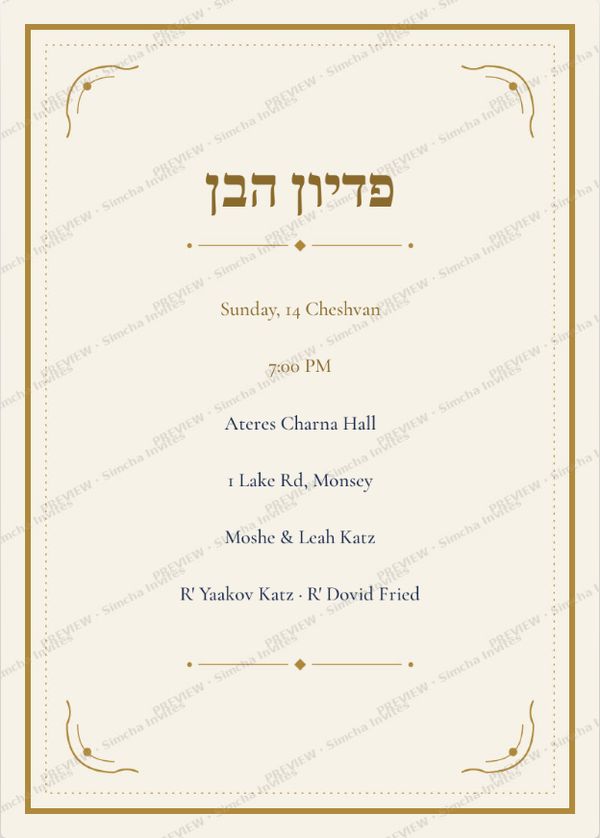
Step 4: the Pidyon Haben (day 31, when it applies)
A Pidyon Haben (פדיון הבן) is the redemption of a firstborn son from a kohen. It is held on day 31 after the birth, and only in certain cases: the baby is his mother's firstborn, born naturally, and neither parent is from a family of kohanim or leviim. There are more details, so ask your Rav whether a pidyon haben applies to your son. It is not held on Shabbos or Yom Tov; if day 31 falls then, it is moved, and your Rav will tell you to when.
Unlike the bris, the pidyon haben date is known weeks ahead, so the card can go out with more notice. It is often held in the evening, with a seudah, and the kohen's name is usually printed.
Sample: Hebrew
בשבח והודי' להשי"ת
הננו מתכבדים להזמין את כל קרובינו ידידינו ומכירינו
להשתתף בשמחת פדיון הבן
של בננו בכורנו ___ נ"י
אשר תתקיים אי"ה ביום ___ פרשת ___
בשעה ___ באולם ___
הכהן: הרב ___ הכהן שליט"א
___ ומשפחתו
Sample: English
With gratitude to Hashem
we invite you to the
Pidyon Haben
of our firstborn son ___
Sunday evening, Parshas ___, at 7:00 PM
at ___
Kohen: Rabbi ___ Kohen
By now the baby has his name, so it goes on the card. More samples are in our Pidyon Haben wording guide.
Phrases on bris cards and what they mean
| Phrase | Meaning |
|---|---|
| בשבח והודי' להשי"ת | With praise and thanks to Hashem |
| הכנסת בננו בבריתו של אברהם אבינו ע"ה | Bringing our son into the covenant of Avraham Avinu |
| בננו הרך הנולד | Our newborn son (used before the name is given) |
| בכורנו | Our firstborn |
| בשעטומ"צ | In a good and successful hour |
| אחר תפלת שחרית | After shachris |
| סעודת מצוה | The seudah of the mitzvah, after the bris |
| במקום הנ"ל | At the place mentioned above |
| הסנדק / בסנדקאות | The sandek / with the sandek being |
| אור ליום ___ | The night before day ___ (for the vachnacht) |
| שינוי זמן | Change of time |
| המצפים לקבל פניכם בשמחה | Who look forward to greeting you with joy |
For abbreviations like הי"ו, שליט"א and לפ"ק, see our guide to Yiddish and Hebrew invitation abbreviations.
Special family situations
- Twins. Write בנינו התאומים, "our twin sons". If both brissin are the same day, one card is enough. If one baby's bris is delayed, send a separate card when the date is set.
- Bris at the grandparents' shul. Write the grandfather's shul with its full address, since many guests will not know it. Some families add בבית מדרשו של זקננו.
- Out-of-town bris. When the mother and baby are staying with her parents in another city, write the city clearly. Guests at home may only come to a local kiddush or l'chaim later.
- After a long wait. Some families add a line of extra thanks, like על החסד אשר גמלנו. Keep it simple and modest.
- A baby named after a grandparent. Don't hint at the name on the card. The name is announced at the bris.
- Bris in the hospital. When the bris must be held in the hospital, the guest list is often very small. A short WhatsApp message to close family is usually enough.
Making the cards on our site
Since we don't have a bris design, here is the honest way to use what we have for the week of a baby boy:
- Open our Baby Boy category. You will see the Sholom Zucher, Vachnacht and Pidyon Haben designs.
- For the first Friday night, tap the Sholom Zucher design. For the bris, many families use the Vachnacht design and add the bris time and shul in the boxes, since the two are announced together.
- Type your text into each box: Hebrew, Yiddish, English or mixed. The card updates as you type.
- Choose a font for each text box, and use A− and A+ to make lines smaller or bigger. Tap a line on the card to select its box. Reset puts it back.
- Check the live preview on your phone. Before paying, the preview is watermarked.
- Place the order and pay. The price is $15 per invitation.
- Download your 3 files: the print PDF, the "Full quality – for printing" JPG (2550 px wide, 300 dpi), and the "Small – for texting (MMS), under 1 MB" JPG for WhatsApp, text messages and email.
- Send the small JPG to your family groups and print the PDF for the shul board.
A month later, if a pidyon haben applies, come back for the Pidyon Haben design.
Checklist before you send
- The bris day is confirmed by the mohel.
- Weekday, parsha and Hebrew date checked against a luach.
- The vachnacht is the night before that bris day.
- Shachris time and "bris right after", or the exact bris time.
- Full name and address of the shul or hall.
- Seudas mitzvah place, if different.
- No baby name on the sholom zucher, vachnacht or bris card.
- Sandek line only if the family agreed, with the right titles.
- Parents' and grandparents' names spelled the way the family writes them.
- One look at the card on a phone screen before sending.
Common mistakes
- Counting the eighth day wrong. A birth after nightfall belongs to the next day. Let the mohel or Rav confirm.
- Sending before the bris is confirmed. If the baby is not ready, the card must be corrected, and the old one keeps circulating.
- Only "at our shul". Guests from other shuls and other neighborhoods need the shul's name and address.
- Writing the name too early. In most families the name is a surprise until the bris.
- Forgetting the seudah. Guests plan around it, especially on a weekday morning before work.
- A huge photo on WhatsApp. Send the small JPG; big files arrive blurry or fail on flip phones.
- Mixing up the night. "ליל ד'" is Tuesday night. Add the hour or write the weekday in plain words.
Frequently asked questions
Do you sell a bris invitation design?
Not yet. Our Baby Boy category has Sholom Zucher, Vachnacht and Pidyon Haben designs, each with its own fixed heading. Many families announce the bris on the vachnacht card, since the two are only a day apart.
Should the baby's name be on the bris invitation?
Usually not. In most heimish families the name is first said at the bris, so the card says בננו or בננו הרך הנולד, "our newborn son". The name does go on the pidyon haben card.
How early is a bris usually held?
Many families hold it early in the morning, right after shachris, because we try to do a mitzvah as early as possible. Others choose later in the morning so more family can come. The mohel and your Rav guide the timing.
Is it rude not to send a formal invitation to a bris?
No. It is widely said that one should not formally invite people to a bris, so many families word it as an announcement or an open invitation to all friends. Customs differ; ask your Rav.
Should I print the sandek's name?
Customs differ. Many families announce the honors only at the bris. Some print the sandek, especially a Rebbe or Rav. Ask the family first, and don't print women's honors.
Can I put the vachnacht and the bris on one card?
Yes, this is very common. Put the vachnacht block first (evening, at home) and then the bris block (morning, shul), each with its own day, time and place.
What if the bris is on Shabbos?
Send everything before candle lighting on Friday. The vachnacht is then on Friday night, and many families combine it with the sholom zucher on one card. The bris is usually in shul after davening.
How much notice should a bris card give?
Usually only a day or two, because the date is confirmed late. Send it as soon as the mohel gives the go-ahead. See our guide on when to send simcha invitations.
What does a pidyon haben card need that a bris card doesn't?
The baby's name, the kohen's name, and usually an evening time and a hall. It also goes out earlier, since day 31 is known weeks ahead. Ask your Rav whether a pidyon haben applies.
Which file should I send on WhatsApp?
Send the "Small – for texting (MMS), under 1 MB" JPG. It opens fast on WhatsApp, on text messages and on flip phones. Use the PDF to print a copy for the shul board.
Can I write the card in Yiddish and English?
Yes. Each text box on our designs takes Hebrew, Yiddish, English or a mix. Many families put Hebrew or Yiddish on top and a short English summary below.
What if the bris is postponed after the card went out?
Send a new card with a clear first line like שינוי זמן or "New date", and ask the people who forwarded the first card to forward the new one.
Mazel tov
A baby boy brings a busy, happy week. Keep each card short, check the day with the mohel, and send the small file so everyone can open it. When you are ready, start with the Baby Boy designs, and may you raise him l'Torah, l'chuppah ul'maasim tovim.