Upsherin Invitation Wording (Yiddish, Hebrew & English)
What an upsherin is, the customs around a boy's first haircut at age three, and complete sample upsherin invitations in Yiddish, Hebrew and English, for a home, a shul or Meron.
Updated November 8, 2026
What is an upsherin?
An upsherin (אפשערן, Yiddish for "cutting off") is the first haircut of a Jewish boy, made when he turns three. Until then many families do not cut his hair at all. At the upsherin his hair is cut for the first time, and his payos (sidelocks) are left in place. In Eretz Yisroel and in many Sephardi homes it is called a chalakah (חלאקה). In Hebrew it is also called תספורת ראשונה, "the first haircut".
The custom is connected to the mitzvah of orlah, where the fruit of a tree is not eaten for its first three years. The child, like a young tree, is left to grow, and at three he begins his life of Torah and mitzvos in a new way. From the upsherin many boys start wearing a yarmulke all day and a small tallis koton (tzitzis), and they begin to learn the aleph-beis.
The upsherin is a happy, warm family simcha. It can be small, at home with the grandparents, or large, in a shul or hall, or at the kever of Rabbi Shimon bar Yochai in Meron. Customs differ a great deal between chassidus, kehillos and families. Some families do not keep the custom at all. This guide describes common practice; for your own family, follow your minhag and ask your Rav.
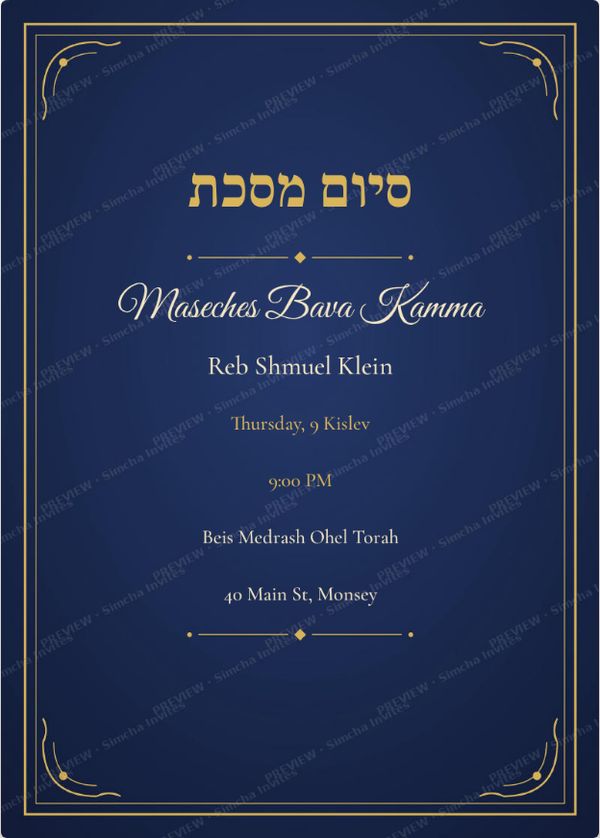
Honest note: we don't have an upsherin design yet. Every design on our site has its own fixed Hebrew heading, such as שלום זכר or סיום מסכת, so for now an upsherin card is best made by a designer or with a blank layout. Our Others category covers other simchas such as a Siyum. The wording below works on any card.
Customs you may want to mention on the card
An invitation doesn't need to explain the customs, since most guests know them. But it helps to know them, because they shape the time, the place and the program you write on the card.
Who gives the first cut
The first snip is an honor. In many chassidish families the boy is brought to the Rebbe, who cuts the first lock; this is sometimes done privately, before or after the family simcha. Others give the first cut to a Rav, a grandfather, a great-grandfather or a respected talmid chacham. After the first cut, family members and guests often each cut a small lock, and at the end a barber finishes the haircut neatly, leaving the payos.
The payos
The payos are left at the sides of the head. Each community has its own style of payos, and the barber or a family member usually knows how the family keeps them. Some families make a point of the moment the payos are first seen, and say a few words.
The aleph-beis with honey
In many homes the boy is shown the letters of the aleph-beis, often on a card or a board, with a little honey on the letters. He licks the honey, so that Torah will always be sweet to him. Some families do this at the upsherin itself. Others do it on his first day in cheder, when his father, sometimes wrapping him in a tallis, carries him to cheder. Guests may also give him candies or coins as he says the letters.
Tzedakah
Many families give tzedakah at the upsherin. A well-known custom is to weigh the cut hair and give its weight in silver or in money to tzedakah. Others give a set sum, or put a pushka on the table so the boy can put in coins.
Meron and Lag BaOmer
Many families, especially chassidish and Sephardi ones, make the upsherin in Meron, at the kever of Rabbi Shimon bar Yochai, often on or around Lag BaOmer. Some families whose son turns three during Sefirah wait until Lag BaOmer for the haircut. Others make it in Meron at another time of year. Families abroad who can't travel may make it on Lag BaOmer at home or in shul. Customs differ about exactly when to make it; ask your Rav.
On which day
Many make the upsherin on the boy's third birthday by the Hebrew date, or soon after. When the birthday falls in a time when haircuts are not given, such as Sefirah (until Lag BaOmer, depending on the family's custom) or the Three Weeks, families wait until the haircut is allowed again. Haircuts are not given on Shabbos or Yom Tov, and most families also avoid Chol Hamoed, so an upsherin is usually held on an ordinary weekday. Some make a kiddush in shul on the Shabbos before.
Customs at a glance
| Custom | What it is | Card line? |
|---|---|---|
| Age three | The first haircut, at three years by the Hebrew date or soon after | בהגיעו לגיל שלש שנים |
| First cut | An honor for a Rebbe, Rav or grandfather | Optional, with family agreement |
| Payos | Left uncut at the sides | Not usually |
| Aleph-beis with honey | The boy licks honey from the letters | Sometimes, as a program line |
| Tzedakah | Often the weight of the hair, or a set sum | Not usually |
| Meron | At the kever of Rabbi Shimon bar Yochai, often around Lag BaOmer | Yes: write the place and meeting point |
| Yarmulke and tzitzis | Many boys start wearing them from the upsherin | No |
What goes on an upsherin invitation
- An opening: ב"ה, בס"ד or בעזהשי"ת.
- A line of thanks: בשבח והודי' להשי"ת.
- The heading: אפשערן, חלאקה, תספורת ראשונה, or "Upsherin" in English.
- The boy's name with a title, for example בננו ___ שיחי' or נ"י.
- The occasion: בהגיעו לגיל שלש שנים, "as he reaches the age of three". Some write לחינוך or add the hope he grows in Torah.
- The day, the parsha or the Hebrew date, and the time.
- The place, with the full address. For Meron, the exact meeting point.
- Program lines if you want them: the first cut, the aleph-beis, a l'chaim or seudah.
- The parents' names, and often the grandparents'.
Sample upsherin invitations
1. Chassidish Yiddish, at home
מיט א הארציגן דאנק צום אייבערשטן
לאדענען מיר אייך הערצליך איין
צום אפשערן
פון אונזער זון ___ שיחי'
ווען ער ווערט אי"ה דריי יאר אלט
וואס וועט זיין אי"ה זונטאג, פרשת ___
פון ___ ביז ___ אזייגער
ביי אונז אין דער היים, ___
מיר ווארטן אייך מיט פרייד
___ און משפחה
2. Classic Hebrew, in shul
בשבח והודי' להשי"ת
הננו מתכבדים להזמין את כל קרובינו ידידינו ומכירינו
להשתתף בשמחת התספורת הראשונה (אפשערן)
של בננו ___ שיחי'
בהגיעו לגיל שלש שנים
אשר תתקיים אי"ה בשעטו"מ
ביום ___ פרשת ___, ___ לחודש ___ תשפ"ז לפ"ק
בשעה ___
בביהמ"ד ___, ___
המצפים לקבל פניכם בשמחה
ההורים: ר' ___ הי"ו וזוגתו תחי'
הסבים: הרה"ח ר' ___ הי"ו · הרה"ח ר' ___ הי"ו
3. Hebrew, chalakah in Meron
בשמחה ובהודאה להשי"ת
הננו מזמינים אתכם לשמחת החלאקה
של בננו ___ נ"י
אשר תתקיים אי"ה
בציון הקדוש של רבי שמעון בר יוחאי זיע"א במירון
ביום ___ ___ לחודש ___ בשעה ___
נקודת מפגש: ___
___ ומשפחתו
4. Yeshivish English
With gratitude to Hashem
we invite you to the
Upsherin
of our son ___
upon his third birthday
Sunday, Parshas ___, at 11:00 AM
at our home, ___
Light lunch to follow
___ and ___ ___
5. Bilingual card
אפשערן
לבננו ___ שיחי' בהגיעו לגיל שלש
ביום א' פרשת ___ בשעה 4:00
בבית זקנינו, ___
at Zaidy and Bubby's home, ___
The first cut at 4:30 · Aleph-beis with honey · L'chaim
6. Short Yiddish with a program
אפשערן פון אונזער ___ שיחי'
מיטוואך, ___ לחודש ___
4:30 · דער ערשטער שניט
5:00 · אלף-בית מיט האניג
5:30 · לחיים
אין זאל ___, ___
7. Twins
בשבח והודי' להשי"ת
הננו מתכבדים להזמינכם לשמחת האפשערן
של בנינו התאומים ___ ו___ שיחיו
בהגיעם לגיל שלש שנים
ביום ___ בשעה ___ בביתנו ___
___ ומשפחתו
8. A first cut by the Rebbe or a Rav
When a Rebbe or Rav gives the first cut at the simcha itself, and the family wants to print it, one line is enough. Ask the family and the gabbai before printing.
9. Lag BaOmer upsherin at home or in shul
For families who wait for Lag BaOmer but can't travel to Meron, a card for an evening or daytime upsherin close to home:
בשבח והודי' להשי"ת
הננו מתכבדים להזמינכם לשמחת האפשערן
של בננו ___ שיחי'
אשר תתקיים אי"ה ביום ל"ג בעומר
בשעה ___ בביהמ"ד ___, ___
אחר האפשערן: לחיים וכיבוד
___ ומשפחתו
Some shuls hold several upsherins together on Lag BaOmer. If yours does, write the shul's time and add your son's name so guests know whose simcha they are coming for.
At home, in shul or in Meron
| Where | Good for | What to write |
|---|---|---|
| At home | Family and close friends; a relaxed afternoon | Address, a time range, any program times |
| Grandparents' home | When the grandparents host or live nearby | בבית זקנינו or בבית הורינו, with the address |
| Shul or Beis Medrash | A bigger crowd, often after davening | Shul name, address, the time after shachris or mincha |
| Hall | A large family with a seudah | Hall name, address, time of the meal |
| Meron | Families who keep that custom, often around Lag BaOmer | The day and time, a clear meeting point, a phone number for finding each other |
Meron can be very crowded, especially on Lag BaOmer itself. If you make the upsherin there, write a meeting point that people can actually find, and add a contact phone number on the card. Many families keep the Meron part small and make a l'chaim at home afterwards for everyone else.
Phrases and what they mean
| Phrase | Meaning |
|---|---|
| אפשערן | Upsherin, the first haircut (Yiddish) |
| חלאקה | Chalakah, the same simcha (common in Eretz Yisroel and Sephardi homes) |
| תספורת ראשונה | First haircut (Hebrew) |
| בהגיעו לגיל שלש שנים | As he reaches the age of three |
| שיחי' / נ"י | Titles after a boy's name: "may he live", "may his light shine" |
| בנינו התאומים שיחיו | Our twin sons |
| בציון הקדוש ... במירון | At the holy kever ... in Meron |
| דער ערשטער שניט | The first cut (Yiddish) |
| אלף-בית מיט האניג | Aleph-beis with honey (Yiddish) |
| נקודת מפגש | Meeting point |
For more titles and abbreviations, see our guide to Yiddish and Hebrew invitation abbreviations.
The Shabbos kiddush before an upsherin
Some families also make a kiddush in shul on the Shabbos before the upsherin, or on the Shabbos of the boy's birthday. The kiddush card is a separate, short card, sent on Thursday or Friday before Shabbos.
הננו מזמינים את כל המתפללים
לקידוש בשב"ק פרשת ___ אחר התפלה
לרגל האפשערן של בננו ___ שיחי'
___ ומשפחתו
Our Kiddush designs carry the heading קידושא רבא and are made for a baby girl's kiddush, so for this kiddush a plain card or a WhatsApp message is usually simpler. More kiddush wording is in our Kiddush wording guide.
Making an upsherin card today
Since our site has no upsherin design yet, here are honest options:
- A designer. A local graphic designer or print shop can lay out the wording above on a card with the heading you want. Give them the text already checked, so they only design.
- A blank layout. Any simple card layout with a plain border works. Put the heading on top, the boy's name in large letters, then the day, time and place.
- A WhatsApp message. For a small family upsherin at home, many parents just send a short text. See the samples in the next section.
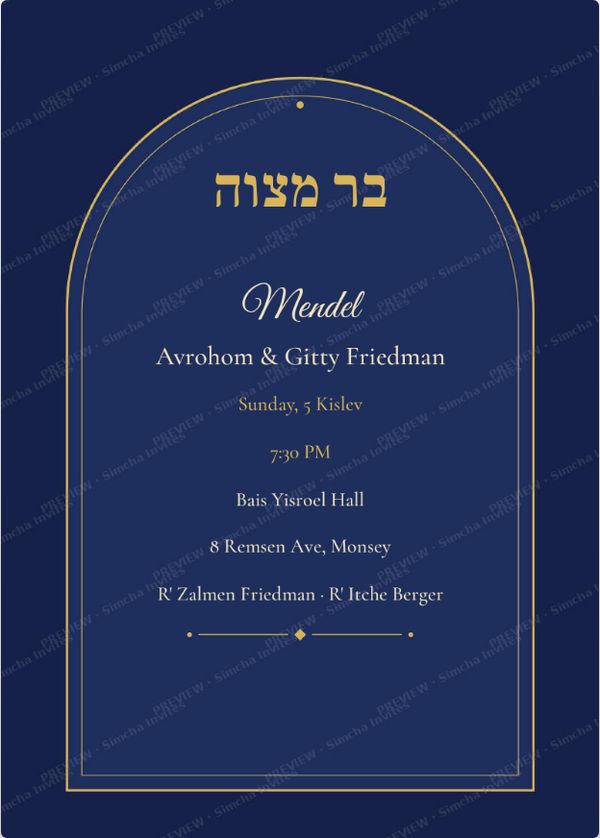
Please don't take one of our designs with a different heading and use it for an upsherin; the heading is fixed and guests will be confused. For the other simchas in your family, browse all our designs. Our Others category has a Siyum design, and the boy's later simchas, like a bar mitzvah, have their own designs.
When you do use one of our designs for another simcha, the steps are: pick the design, type into each box (Hebrew, Yiddish, English or mixed), choose a font and use A− / A+ for size, check the watermarked preview, pay $15, and download the PDF, the full-quality JPG and the small JPG for texting.
Sending it on WhatsApp and by text
Most upsherin invitations are sent on WhatsApp, to the family group and to friends. Keep the picture small so it opens quickly, and send a plain text line for relatives with kosher phones. Our guide to sending simcha invitations on WhatsApp or by text covers file sizes, broadcast lists and flip phones.
When to send it
An upsherin is planned ahead, so you can send the card one to three weeks before. For Meron, give more notice, since people need to arrange travel. For a small home upsherin, a few days is often enough. Send a short reminder the day before. If it falls right after Lag BaOmer or right after the Three Weeks, send it early so it doesn't get lost among other simchas. See our full guide on when to send simcha invitations.
Checklist before you send
- The date is on or after his third birthday, by the Hebrew date, as your family does it.
- Not in Sefirah or the Three Weeks unless your custom allows it, and not on Shabbos or Yom Tov.
- The heading your family uses: אפשערן, חלאקה or "Upsherin".
- The boy's name spelled the way the family writes it, with שיחי' or נ"י.
- Day, parsha or Hebrew date, and the hour.
- The full address, or the Meron meeting point and a phone number.
- Program times, if guests come for a set moment (the first cut, the aleph-beis).
- The first-cut honor printed only with the family's and gabbai's agreement.
- Parents' and grandparents' names and titles checked.
- One look at the card on a phone before sending.
Common mistakes
- Counting the birthday by the English date when the family goes by the Hebrew date. Check a luach.
- Planning during Sefirah or the Three Weeks without checking the family's custom.
- No meeting point in Meron. "In Meron" is not enough on a crowded day.
- Only a time for the start. If people come for the first cut, write when it is.
- Too much explanation. The card is an invitation, not an essay about the custom. A short heading and the details are enough.
- A huge picture file on WhatsApp. It opens slowly and fails on flip phones. Send a small JPG.
- Using a card with a different heading. A card that says another simcha on top confuses guests.
Frequently asked questions
What is an upsherin?
An upsherin (אפשערן) is a boy's first haircut, usually at age three. The hair is cut, the payos are left, and many boys start wearing a yarmulke and tzitzis and learning the aleph-beis from then.
What is the difference between an upsherin and a chalakah?
They are the same simcha. Upsherin is the Yiddish name; chalakah (חלאקה) is the name used in Eretz Yisroel and in many Sephardi homes.
Do you sell an upsherin invitation design?
Not yet. Each of our designs has a fixed heading, so for now an upsherin card is best made by a designer or with a blank layout. Our Others category covers other simchas such as a Siyum.
Who gives the first cut?
It is an honor, often given to a Rebbe, a Rav or a grandfather. Then family and guests may each cut a small lock, and a barber finishes the haircut. Customs differ between families.
Should the first-cut honor be printed on the card?
Usually it is not needed. If a Rebbe or Rav gives the first cut at the simcha and the family wants guests to know, one line is enough. Ask the family and the gabbai first.
When is the upsherin made?
Many make it on the third birthday by the Hebrew date, or soon after. If the birthday falls in Sefirah or the Three Weeks, many wait, and some wait for Lag BaOmer. Ask your Rav.
Why do people make an upsherin in Meron?
Many families have the custom to make it at the kever of Rabbi Shimon bar Yochai in Meron, often around Lag BaOmer. If you do, write a clear meeting point and a phone number on the card.
What is the honey and aleph-beis custom?
The boy is shown the letters with a little honey on them and licks it, so Torah will be sweet to him. Some do it at the upsherin, others on his first day in cheder.
Is tzedakah part of the upsherin?
Many families give tzedakah. A known custom is to weigh the cut hair and give its weight in silver or money. Others give a set sum.
How far ahead should I send an upsherin invitation?
About one to three weeks, more for Meron, and a reminder the day before. See our guide on when to send simcha invitations.
Can an upsherin be on Shabbos?
No, hair is not cut on Shabbos or Yom Tov. Some families make a kiddush in shul on the Shabbos before and the upsherin on a weekday.
What should I write in English?
Keep it simple: "We invite you to the Upsherin of our son ___ upon his third birthday", then the day, time and address.
Mazel tov
An upsherin is the start of a boy's journey in Torah. Keep the card short and warm, check the date, and make sure guests can find you. May you have much nachas, and may he grow l'Torah, l'chuppah ul'maasim tovim.