Aufruf Invitation Wording (Yiddish, Hebrew & English)
How to word an invitation for the aufruf, the Shabbos before the chasuna when the chosson is called up to the Torah, with the kiddush, the chassidish bavarfen, sample wordings in Yiddish, Hebrew and English, and a Shabbos schedule card.
Updated November 8, 2026
The Shabbos before the chasuna
A few days before the chasuna, the chosson is called up to the Torah in shul. The tzibbur sings, sweets are thrown, and after davening the family makes a kiddush in his honor. In yeshivish and many Ashkenazi communities this is called the aufruf (also written oifruf or ufruf, from the Yiddish אויפרופן, "calling up"). In many chassidish communities the same Shabbos, or its kiddush, is called the bavarfen (באווארפן, "throwing"), after the sweets thrown at the chosson.
This guide explains what happens on that Shabbos, the differences between yeshivish and chassidish customs, who invites, and what to write. You will find complete sample wordings in Yiddish, Hebrew and English, a kiddush notice, a short WhatsApp version, a Shabbos schedule card, and a checklist. For the chassidish bavarfen in more detail, see our Bavarfen wording guide.
Customs for the aufruf differ a great deal between communities, shuls and families: which Shabbos, which aliyah, whether sweets are thrown, and what the kiddush looks like. Treat everything here as common practice, and ask your family and your Rav what you do.
What happens at an aufruf
- The aliyah. On the Shabbos before the chasuna, the chosson is called up to the Torah. In many shuls he gets an honored aliyah, often shlishi or maftir; in some he also reads the haftorah. This differs from shul to shul.
- The singing and the sweets. After his aliyah, in many shuls the people sing a song of mazel tov, and soft candies or small bags of sweets are thrown toward the chosson, a wish for a sweet life. (Many shuls ask people to throw soft sweets only, gently.)
- A Mi Sheberach. The gabbai often says a special Mi Sheberach for the chosson and his family.
- The kiddush. After davening the chosson's family makes a kiddush, in the shul hall or at home. This is the part most people are invited to.
- Sometimes a Shabbos for the family. Some families host relatives for the whole Shabbos, with seudos on Friday night and Shabbos day. Then a schedule card helps.
In many communities the kallah does not attend the aufruf in shul, and she has her own Shabbos with her friends (often called Shabbos kallah). That is a separate event with its own arrangements; this guide is about the chosson's aufruf.
Aufruf, bavarfen and "Shabbos chosson": the names
The same Shabbos goes by several names, and some names mean different things in different communities. Use the word your family and shul use, so guests know exactly what you mean.
| Name | Who commonly uses it | What it usually means |
|---|---|---|
| Aufruf / oifruf / ufruf (אויפרופן) | Yeshivish, Litvish, modern and many Ashkenazi families | The chosson's aliyah on the Shabbos before the chasuna, and the kiddush after |
| Bavarfen (באווארפן) | Many chassidish families | The aufruf Shabbos, named after the sweets thrown; often refers to the kiddush |
| Shabbos aufruf / שבת אויפרופן | Many communities | The whole Shabbos before the chasuna |
| Shabbos chosson (שבת חתן) | Used in different ways | In some communities the aufruf Shabbos before the chasuna; in many Sephardic and some other communities, the Shabbos after the chasuna, during sheva brachos |
Because "Shabbos chosson" can mean the Shabbos before or after the chasuna, it is safer on an invitation to add a clear word: "Shabbos Aufruf, the Shabbos before the chasuna" or "Shabbos Sheva Brachos". If your Shabbos is after the chasuna, our Sheva Brachos wording guide is the better fit.
Yeshivish and chassidish: the main differences
| Topic | Many yeshivish families | Many chassidish families |
|---|---|---|
| Name | Aufruf, Shabbos Aufruf | Bavarfen, Shabbos Aufruf, אויפרופן |
| Card language | English, or English with a Hebrew heading | Yiddish or lashon kodesh |
| The kiddush | In the shul hall after davening; often open to the whole shul | In the shul or the Beis Medrash after davening; family, friends and the chosson's friends |
| Where | Often the chosson's home shul, or his father's shul | Often the father's shul or the Rebbe's Beis Medrash |
| Extra events | Sometimes a Friday night oneg or a seudah for out-of-town family | Sometimes a Friday night gathering, a tish or a seudah for family; customs differ |
These are broad patterns, not rules. Plenty of chassidish families say "aufruf" and plenty of yeshivish families keep older customs from their parents' homes.
Who invites
The aufruf is the chosson's simcha, so the invitation usually comes from the chosson's parents. Some variations:
- The parents alone, the most common: "Mr. and Mrs. ______ invite you to the aufruf of their son".
- The parents together with the shul, when the kiddush is in the shul and the shul announces it: "The Rav and the members of Kehillas ______ invite you, together with the family, to the kiddush in honor of the aufruf of ______".
- The grandparents, when the aufruf is in a grandparent's shul or the grandparents host: write בהשתתפות זקנינו or "together with the chosson's grandparents".
- Friends of the family, who sometimes sponsor the kiddush in the chosson's honor. Then the notice says "The kiddush is sponsored by ______ in honor of the aufruf of ______".
The kallah's family is usually named with respect, as "son of / engaged to ______, daughter of ______", so guests know which chasuna this is.
What goes on an aufruf invitation
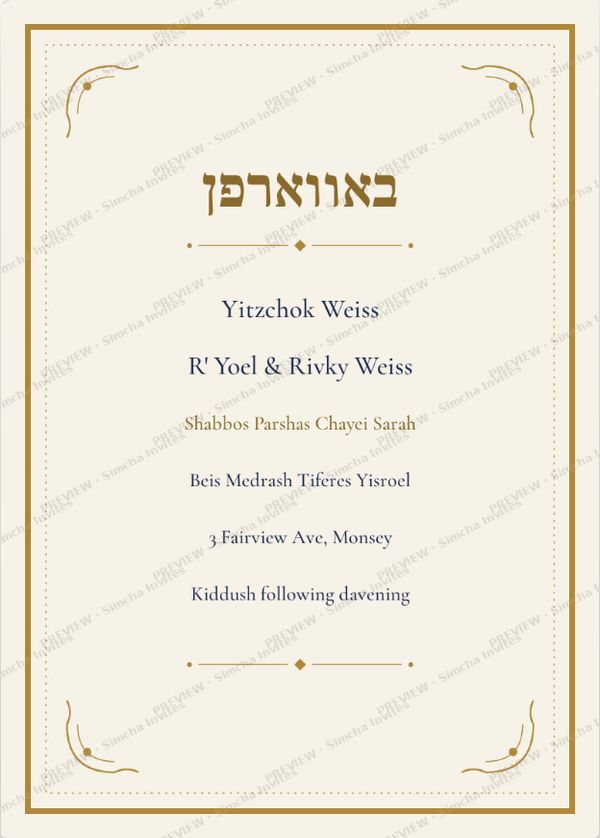
- A heading: אויפרופן, באווארפן, "Aufruf" or "Kiddush in honor of the Aufruf".
- An opening line, such as ב"ה and בשבח והודי' להשי"ת.
- Who invites (usually the chosson's parents).
- The chosson's name with נ"י, and the kallah's name with תחי' and her father's name.
- The Shabbos: שבת קודש פרשת ______, the Hebrew date, and the civil date for English readers.
- The shul's name and full address.
- The time: when davening starts, or "kiddush after davening". Many cards give the davening time, since the aliyah is in the middle of davening.
- Where the kiddush is (the shul hall, the Beis Medrash, the family's home).
- Optionally: the chasuna date ("the chasuna will take place, b'ezras Hashem, on ______"; for the chasuna card itself see our chasuna wording guide), a Friday night gathering, or a seudah.
Sample wording in Hebrew (lashon kodesh)
בשבח והודי' להשי"ת
הננו מתכבדים להזמין את כבודו
להשתתף בשמחת האויפרופן
של בננו החתן המופלג ______ נ"י
עב"ג הכלה המהוללה ______ תחי'
בת הרה"ח ר' ______ הי"ו
אשר תתקיים אי"ה בשבת קודש פרשת ______
______ תשפ"ז לפ"ק
בביהמ"ד ______, ______
תפלת שחרית בשעה ______
קידוש אחר התפלה
המצפים לקבל פניכם בשמחה
______ ומשפחתו
בביהמ"ד is short for בבית המדרש, "in the Beis Medrash". If the kiddush is in another place, add a line: הקידוש יתקיים אי"ה בבית ______.
Sample wording in Yiddish, chassidish style
מיט שבח והודי' צום אייבערשטן
לאדענען מיר אייך הערצליך איין
צו דעם באווארפן
פון אונזער זון החתן ______ נ"י
עב"ג הכלה ______ תחי'
בת הרה"ח ר' ______ הי"ו
שבת קודש פרשת ______
אין בית המדרש ______, ______
שחרית: ______ אזייגער
קידוש נאך דאווענען
אייער קומען וועט פארגרעסערן אונזער שמחה
______ ומשפחתו
Some families write אויפרופן instead of באווארפן, or both: אויפרופן און באווארפן. Our Bavarfen guide has more Yiddish wordings and a full Shabbos schedule.
Sample wording in English, yeshivish style
Mr. and Mrs. ______
invite you to join them
at the Aufruf of their son
______
chosson of ______, daughter of Mr. and Mrs. ______
Shabbos Parshas ______, ______ 2026
Congregation ______, ______
Shacharis 9:00 AM · Kiddush following davening
English cards often say "Kiddush following davening" or "Kiddush to follow" rather than a time, because the kiddush starts when davening ends.
A kiddush notice from the shul
When the kiddush is a shul kiddush, the shul often sends a notice by email or WhatsApp group, and sometimes hangs it on the board before Shabbos. A short, clear version:
in honor of the aufruf of ______
son of Mr. and Mrs. ______
who will be married b'ezras Hashem on ______
to ______, daughter of Mr. and Mrs. ______ of ______
Everyone is invited. Mazel tov!
שבת קודש פרשת ______
קידוש לכבוד האויפרופן
של החתן ______ נ"י
בן הרה"ח ר' ______ הי"ו
הכל מוזמנים · מזל טוב!
Bilingual card
הננו מתכבדים להזמינכם לשמחת האויפרופן
של בננו החתן ______ נ"י
שבת קודש פרשת ______ בביהמ"ד ______
Shabbos Parshas ______, ______ 2026
at ______, ______ · Kiddush after davening
The ______ family
As with every bilingual card, the English only needs the essentials: whose aufruf, which Shabbos, where, and that there is a kiddush.
When the chosson's father is also called up
In some families, the chosson's father (and in some communities the kallah's father, in his own shul) is also given an aliyah on the Shabbos before the chasuna, and sometimes a small kiddush is made for it. Customs differ widely, and many families do nothing special for the father. If your family does, it usually does not need its own card; one line on the aufruf invitation or the shul notice is enough:
לרגל שמחת נישואי בנו החתן ______ נ"י
מזל טוב!
When the kallah's family makes a kiddush in their own shul, the wording is the same with "daughter" instead of "son": לרגל שמחת נישואי בתו הכלה ______ תחי'.
Short WhatsApp version
Most people will get the aufruf invitation on WhatsApp in the days before Shabbos. Send the picture with a short line of text, so the details are there even if the picture does not open:
Send it no later than Friday, well before candle lighting, so nobody needs to read anything on Shabbos. Our guide on sending simcha invitations on WhatsApp or by text explains which file to send and how to send it to many people.
A Shabbos schedule card for family
When relatives come for the whole Shabbos, especially from out of town, one simple schedule card saves a lot of phone calls. Send it before Shabbos, and print a few copies to leave in the guest rooms.
| When | What | Where |
|---|---|---|
| Friday, ______ PM | Candle lighting | — |
| Friday night, after davening | Seudas Shabbos for family | ______ (home or hall) |
| Friday night, ______ PM | Gathering for friends (if your family has one) | ______ |
| Shabbos, ______ AM | Shacharis, the chosson's aliyah | ______ (shul) |
| After davening | Kiddush | ______ (shul hall) |
| Shabbos, ______ PM | Seudah for family | ______ |
| Motzei Shabbos, ______ PM | Shabbos ends | — |
Add where each family is staying, the walking route between the homes and the shul, and a phone number to call before Shabbos with questions. Check candle lighting and the end of Shabbos for your city on a reliable luach.
Phrases on an aufruf card, and what they mean
| Phrase | Meaning | Where it goes |
|---|---|---|
| אויפרופן | Aufruf, "calling up" to the Torah | Heading |
| באווארפן | Bavarfen, "throwing" (the sweets) | Heading, in chassidish cards |
| העלי' לתורה | The aliyah to the Torah | In the wording: לכבוד העלי' לתורה |
| החתן ______ נ"י | The chosson ______, may he be well | After "our son" |
| עב"ג | With his match | Before the kallah's name |
| שבת קודש פרשת ______ | The holy Shabbos of Parshas ______ | The date line |
| בביהמ"ד | In the Beis Medrash | The place line |
| קידוש אחר התפלה | Kiddush after davening | Under the time |
| לרגל שמחת נישואי | On the occasion of the wedding of | Kiddush notices, father's aliyah |
| הכל מוזמנים | Everyone is invited | Shul notices |
For many more abbreviations, see our Yiddish and Hebrew invitation abbreviations guide.
Making it on our site
We don't have an aufruf-titled design yet. What we do have is our Bavarfen designs, which carry the Hebrew heading באווארפן. If your family calls the Shabbos "bavarfen", or is happy with that heading, it is a good fit. If you need the word "Aufruf" or אויפרופן as the main heading, our designs can't change the heading, and the wordings on this page work well as a WhatsApp message or on a card from a designer.
- Open the Bavarfen category at Bavarfen designs and pick a design.
- Type your text in each box: the chosson's name, the kallah and her father, the parsha, the shul and the times. Hebrew, Yiddish, English or mixed all work.
- Choose a font for each box with its own font picker.
- Fit the text with A− and A+, and Reset if you want to start over. Long shul names often need one step smaller.
- Check the live preview, and tap any text on the card to edit that box.
- Order and pay: $15 per invitation. Previews are watermarked until payment.
- Download your three files: a print PDF, a "Full quality – for printing" JPG (2550 px wide, 300 dpi), and a "Small – for texting (MMS), under 1 MB" JPG for WhatsApp and text.
Timing
Many families send the aufruf invitation about one to two weeks before the Shabbos, often together with or soon after the chasuna invitations, and a short reminder on Thursday or Friday morning. A shul kiddush notice usually goes out in the shul's weekly email or WhatsApp group that week. Everything should go out before Shabbos begins. See our guide on when to send simcha invitations for a full timing table for every simcha.
Checklist before you send
- The right Shabbos: the parsha and Hebrew date match the civil date.
- The shul agreed: the gabbai knows about the aliyah, and the shul hall is booked for the kiddush.
- The name your community uses: aufruf, אויפרופן or באווארפן.
- The chosson's name, the kallah's name and her father's name spelled correctly.
- The shul's full name and address.
- Davening time, and "kiddush after davening".
- For out-of-town family: where they stay and the walking route.
- Sent before Friday afternoon, with a text line beside the picture.
- Checked on your phone.
Common mistakes
- Writing only "Shabbos chosson". In some communities it means the Shabbos after the chasuna. Say "aufruf" or "the Shabbos before the chasuna".
- No davening time. Guests who want to hear the aliyah need to know when to come. "Kiddush after davening" alone is not enough for them.
- The wrong shul. Families with two shuls (the father's and the grandfather's) sometimes send last year's address. Write the full address.
- Sending on Friday afternoon. Many people are already busy with Shabbos. Send earlier in the week, and only a short reminder on Friday.
- Hard sweets. If your shul throws sweets, many families put a note in the shul's notice or hand out bags of soft candies, so nobody gets hurt.
- Sending the big print file on WhatsApp. Send the small texting file; it opens fast and stays sharp on a phone.
Frequently asked questions
What is an aufruf?
The aufruf is when the chosson is called up to the Torah on the Shabbos before his chasuna. In many shuls the people sing and throw sweets, and the family makes a kiddush after davening.
What is the difference between an aufruf and a bavarfen?
They are the same Shabbos. Aufruf (calling up) is the common yeshivish and Ashkenazi name; bavarfen (throwing) is the name many chassidish families use, after the sweets thrown at the chosson.
Is the aufruf always the Shabbos right before the chasuna?
Usually, yes. Customs differ, and some families hold it a Shabbos earlier for practical reasons. Ask your family and your Rav.
What does "Shabbos chosson" mean?
It depends on the community. Some use it for the aufruf Shabbos before the chasuna, while many Sephardic and some other communities use it for the Shabbos after the chasuna, during sheva brachos. Write clearly which one you mean.
Who sends the aufruf invitation?
Usually the chosson's parents. Sometimes the shul sends a kiddush notice, or friends sponsor the kiddush and announce it.
Does the kallah attend the aufruf?
In many communities the kallah does not come to the chosson's aufruf and has her own Shabbos with friends. Customs differ, so follow your family.
Should the kallah's name be on the aufruf card?
Many families include it, with her father's name, so guests know which chasuna it is. Some keep the card to the chosson's name only.
What time should an aufruf card give?
The time Shacharis begins, and "kiddush after davening". Guests who want to hear the aliyah come for davening; others come for the kiddush.
Is the chosson's father also called up?
In some families the father of the chosson, or of the kallah in his own shul, gets an aliyah on that Shabbos, sometimes with a small kiddush. Many families do nothing special. Customs differ.
Do you have aufruf designs?
Not with an aufruf heading. Our Bavarfen designs carry the heading באווארפן, which fits families who use that name.
How much does a Bavarfen invitation cost?
$15 per invitation, with a print PDF, a full-quality JPG and a small JPG for texting.
When should we send the aufruf invitation?
Many families send it one to two weeks before, with a short reminder later in the week, and always before Shabbos begins.
Mazel tov
The aufruf is the first public simcha of the chasuna week: the whole shul shares in the chosson's joy. A clear card with the right Shabbos, the right shul and the davening time is all guests need. Wishing the chosson and kallah and both families much simcha, and may they build a בית נאמן בישראל.