Bas Mitzvah Invitation Wording (Hebrew, Yiddish & English)
How to word a bas mitzvah (בת מצוה) invitation the heimish way: for a family seudah, a Shabbos kiddush or a class celebration, with sample cards in Hebrew, Yiddish and English, a checklist and answers to common questions.
Updated November 8, 2026
What is a bas mitzvah?
A girl becomes bas mitzvah (בת מצוה) at the age of twelve. From that day she is obligated in mitzvos like an adult. It is a real milestone, and families mark it with thanks to Hashem and a word of chizuk for the girl.
In heimish circles a bas mitzvah is usually quiet and modest. There is no one way to do it, and customs differ a great deal:
- A small family seudah at home: parents, grandparents, aunts and the girl's sisters and close cousins.
- A kiddush, for example on Shabbos, when the family wants to share the simcha with the shul or neighbors.
- A school or class celebration, often arranged with the teacher: the girl's class comes together, sometimes with a small program, a project or a dvar Torah.
- A gathering for the women and girls of the family, in the evening at home.
- No public celebration at all. Many families mark the day privately, with a new siddur, a gift, a special word from her father or grandfather, and extra tzedakah. That is a full and proper way to mark it.
What your family does is your family's custom. If you are not sure what is done in your circle, ask your family and your Rav. This guide gives you wording for each of the common ways, so the invitation matches the kind of simcha you are making.
Do you even need an invitation?
Often not a printed one. For a small family seudah, a phone call or a short WhatsApp message to the family group is enough. An invitation card helps when:
- you are inviting more people than you can call one by one (the class, the neighbors, the shul);
- grandparents or relatives are coming from out of town and need the time and address;
- you want the girl to have a keepsake of her bas mitzvah;
- the celebration is in a hall or a school, not at home.
A simple, tasteful card fits the spirit of a heimish bas mitzvah better than a large one. Fewer lines, warm words, the facts guests need.
Which kind of bas mitzvah, which kind of invitation
| Kind of celebration | Who is usually invited | Best way to invite |
|---|---|---|
| Family seudah at home | Parents, grandparents, aunts, uncles, cousins | Phone call or WhatsApp message to the family group; a card if many are coming |
| Women and girls of the family | Mother, grandmothers, aunts, sisters, cousins | A short card or message sent only to them |
| Class celebration | The girls of her class, often with their mothers | A card sent through the class mothers, after the teacher agrees |
| Shabbos kiddush | The shul, neighbors, friends | A kiddush card sent during the week |
| No public celebration | No one, or only grandparents | No invitation needed; a call to the grandparents |
What goes on a bas mitzvah invitation
- The opening: ב"ה, בס"ד or בעזהשי"ת.
- A line of thanks: בשבח והודי' להשי"ת.
- The heading: בת מצוה (some write שמחת בת מצוה).
- Who is inviting: the parents, sometimes with the grandparents.
- The girl's name with שתחי' (or תחי').
- The reason: לרגל הגיע בתנו ___ שתחי' לעול המצוות or simply לרגל שמחת הבת מצוה.
- The day and Hebrew date (and, if you like, the parsha of that week).
- The time.
- The place, with the full address.
- Who it is for, if the event is only for some guests (for example "for family", or "for the girls of the class and their mothers").
- The signature line.
What a heimish bas mitzvah card usually does not have: photos of the girl, a "theme", a dress code, or a long program. Heimish cards are made of words and a tasteful design, and that is what guests expect.
Sample 1: Hebrew card for a family seudah
A classic lashon kodesh card for a seudah at home, sent to the family.
בשבח והודי' להשי"ת
הננו מתכבדים להזמין את כל קרובינו
להשתתף בשמחתנו
לרגל הגיע בתנו היקרה ___ שתחי'
לעול המצוות
בת מצוה
שתתקיים אי"ה ביום ___ פרשת ___
בשעה ___ בערב
בביתנו ___
___ (address)
המצפים לראותכם
___ ומשפחתו
Sample 2: Yiddish card for the family
Many chassidish families write family cards in Yiddish. Short and warm:
מיט גרויס פרייד און דאנק צום אייבערשטן
לאדענען מיר אייך הערצליך איין
צו דער בת מצוה
פון אונזער טאכטער ___ שתחי'
___ (day), פרשת ___
אום ___ אזייגער
ביי אונז אינדערהיים, ___
מיר ווארטן אייך מיט פרייד
___ און משפחה
Sample 3: English card
For relatives and friends who read English best:
With thanks to Hashem
we invite you to join us
as our daughter
___
becomes Bas Mitzvah
___ evening, Parshas ___
at ___ PM
at our home, ___
___ and ___ ___
Sample 4: bas mitzvah hosted by the grandparents
When the seudah is at the grandparents' home, or the grandparents are the ones inviting, name them first and say whose home it is.
ברוב שבח והודי' להשי"ת
הננו מתכבדים להזמין את כל המשפחה
לשמחת הבת מצוה
של נכדתנו ובתנו ___ שתחי'
שתתקיים אי"ה ביום ___
בשעה ___
בבית הזקנים, ___
___ (address)
הזקנים: ___
ההורים: ___
Sample 5: a class celebration
When the girl's class comes for a small celebration, the invitation usually goes from the parents (sometimes together with the teacher) to the girls and their mothers. Keep it simple and clear about who is invited.
Dear girls of Class ___,
please join us for
___'s Bas Mitzvah celebration
___ (day), at ___ PM
at ___ (address)
Mothers are welcome too
The ___ family
The same in Yiddish:
טייערע מיידלעך פון קלאס ___
איר זענט הערצליך איינגעלאדנט
צו דער בת מצוה שמחה פון ___ שתחי'
___ (day), אום ___ אזייגער
ביי ___
די מאמעס זענען אויך איינגעלאדנט
משפחת ___
Sample 6: a Shabbos kiddush for the bas mitzvah
Some families make a kiddush on the Shabbos of the bas mitzvah (or near it), so the shul or the neighbors can wish mazel tov. The card is like any kiddush card, with the reason added.
בשבח והודי' להשי"ת
הננו מתכבדים להזמין את כבודכם
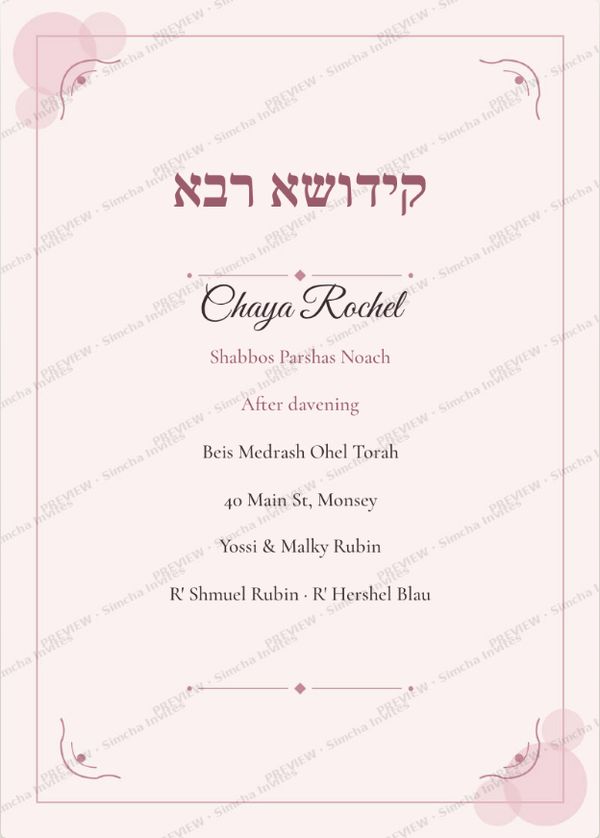
לקידושא רבא
לרגל שמחת הבת מצוה של בתנו ___ שתחי'
שיתקיים אי"ה בשב"ק פרשת ___
אחר התפלה
בביהמ"ד ___
___ ומשפחתו
For more on Shabbos kiddush cards, see our kiddush invitation wording guide.
Sample 7: bilingual card (Hebrew on top, English below)
One card for everyone: the Hebrew or Yiddish block on top, then a short English block with the facts.
בת מצוה
בתנו ___ שתחי'
יום ___ · בשעה ___
בביתנו
___ (day), ___ PM
___ (address)
___ and ___ ___
Sample 8: a twin, or two sisters together
Twin girls share one bas mitzvah. Write both names, in the order the family uses (often the older first). Some families also make one celebration for a girl and a close cousin with the same date.
בשבח והודי' להשי"ת
הננו מתכבדים להזמין את כל קרובינו ומכירינו
לשמחת הבת מצוה
של בנותינו התאומות
___ שתחי' ו___ שתחי'
שתתקיים אי"ה ביום ___ בשעה ___
ב___
___ ומשפחתו
Sample 9: a short WhatsApp message
For a small family seudah, a short message to the family group is often all you need. If you have a card, send the small "for texting" picture with it.
מיר זענען זיך משמח מיט די בת מצוה פון אונזער ___ שתחי'
___ (day) אום ___ ביי אונז
מיר ווארטן אייך!
בשמחה רבה הנכם מוזמנים לשמחת הבת מצוה של בתנו ___ שתחי'
ביום ___ בשעה ___ בביתנו
We'd love you to join us for ___'s Bas Mitzvah
___ (day) at ___ PM, at our home
Mazel tov!
Sample 10: formal English card, yeshivish style
Some families, especially those with many English-speaking relatives, prefer a fuller English card:
With gratitude to Hashem
Rabbi and Mrs. ___ ___
together with
Mr. and Mrs. ___ ___ (grandparents)
invite you to share in their simcha
as their daughter and granddaughter
___
becomes Bas Mitzvah
___ (day), the ___ of ___ (Hebrew month)
at ___ PM
___ (place, address)
When the bas mitzvah is near Yom Tov or another simcha
- Near Yom Tov. If her birthday falls on Yom Tov or chol hamoed, many families make the celebration a few days before or after. Write the day of the celebration, not the birthday, so guests aren't confused.
- During the Omer or the Three Weeks. Families have different customs about celebrations at these times. Ask your Rav before you set a date.
- Close to a sibling's simcha. If a brother's bar mitzvah or a sister's chasuna is the same month, some families combine the bas mitzvah into a family Shabbos or keep it very small. A short message is enough.
Phrases on a bas mitzvah card
| Phrase | Meaning | Where it goes |
|---|---|---|
| בשבח והודי' להשי"ת | With praise and thanks to Hashem | Opening line |
| הננו מתכבדים להזמין | We are honored to invite | Before the simcha |
| לרגל הגיע בתנו לעול המצוות | On our daughter reaching the age of mitzvos | The reason line |
| שתחי' / תחי' | May she live (long) | After the girl's name |
| בתנו היקרה | Our dear daughter | Before her name |
| נכדתנו | Our granddaughter | When grandparents invite |
| בשעה טובה ומוצלחת | At a good and successful time | Optional, after the name |
| המצפים לראותכם | Who look forward to seeing you | Above the signature |
| אי"ה | If Hashem wills | Before the date |
For more abbreviations used on heimish cards, see our Yiddish and Hebrew invitation abbreviations guide.
Choosing the date
A girl becomes bas mitzvah on her twelfth birthday according to the Jewish calendar. Some practical points:
- Use the Hebrew birthday. The English birthday can be weeks away from the Hebrew one. Check her Hebrew date of birth in a luach.
- The night belongs to the next day. If she was born after nightfall, her Hebrew birthday is the next day's date. Check carefully.
- Adar in a leap year. A girl born in Adar whose bas mitzvah year has two Adars: which Adar is her birthday is a question to ask your Rav.
- The celebration can be on another day. Many families make the seudah or class celebration on a convenient evening near the birthday. That's fine; the card simply gives the day of the celebration.
- Not on Shabbos by phone. If the kiddush is on Shabbos, send the card during the week.
Making a bas mitzvah card on our site: what we have, honestly
We don't have a bas mitzvah design yet. Each of our designs has a fixed Hebrew heading, and none of them says בת מצוה. Here is what that means for you:
- If you are making a Shabbos kiddush for the bas mitzvah: our Kiddush design can work. Its heading is קידושא רבא, and you type the reason ("for the bas mitzvah of our daughter ___") in the text boxes, like Sample 6 above. It fits only when the event really is a kiddush.
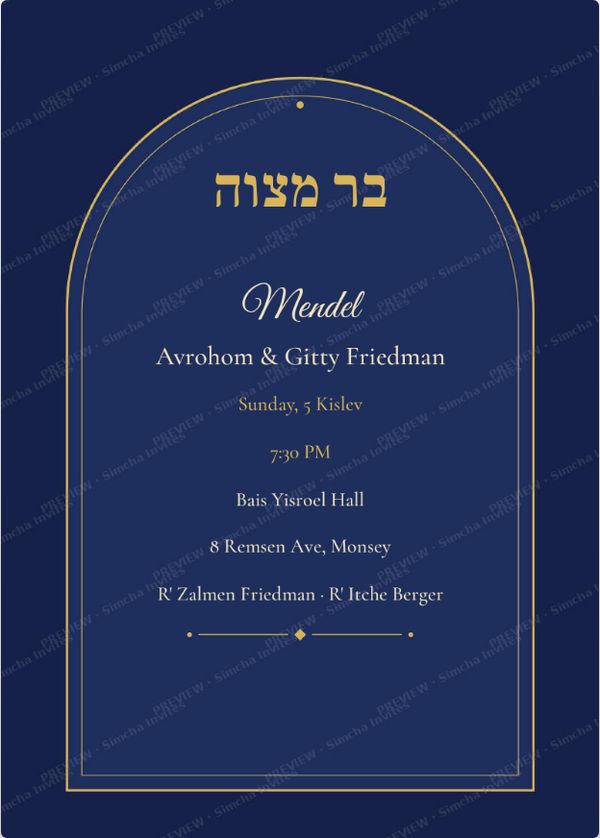
- If you are making a seudah, an evening gathering or a class celebration: none of our current designs fits, because the headings are for other simchas. Please don't use our Bar Mitzvah design (its heading is בר מצוה, for a boy). For these events, a short WhatsApp message (Sample 9) is often enough, or a local designer can make a card with your wording.
If you use our Kiddush design, here is how:
- Open the Kiddush category and tap the design.
- Type your details into each text box: the reason line, the girl's name with שתחי', the parsha, the shul and the signature. You can type Hebrew, Yiddish, English or a mix.
- Watch the live preview as you type.
- Pick a font for each box and use A− or A+ to make a line smaller or bigger; Reset brings it back. Tap a line on the card to jump to its box.
- Check the preview on your phone (it has a watermark until you pay).
- Place the order and pay $15.
- Download the print PDF, the "Full quality – for printing" JPG (2550 px wide, 300 dpi), and the "Small – for texting (MMS), under 1 MB" JPG for WhatsApp and text messages.
Modesty and the bas mitzvah card
A heimish bas mitzvah card is about the simcha, not about pictures. Some tips that fit heimish style:
- No photos of the girl. Heimish cards don't have them. A tasteful design and good words are enough.
- Think about who gets it. A card for the women and girls of the family, or for the class and their mothers, should go to them, not to the shul group or a large public group.
- Keep the wording simple. Thanks to Hashem, the girl's name, the day, the place.
- Be mindful of others. If classmates' families make no celebration, a small, quiet event keeps everyone comfortable. Many schools have their own guidance on class celebrations; ask the teacher.
Sending the invitation
Most families send a bas mitzvah invitation on WhatsApp to the family group, and to the class mothers if the class is invited. Send the small JPG made for texting; it opens quickly and looks sharp. Grandparents with kosher phones can get it by text message (MMS). Our guide on sending simcha invitations on WhatsApp or by text explains which file to send and how to reach people with flip phones.
For timing: a family seudah is often announced a week or two ahead; a class celebration once the teacher agrees on a date; a Shabbos kiddush during the week before. These are common practices, not rules. See our guide to when to send simcha invitations for a full table.
Common mistakes
- Using the English birthday. The bas mitzvah is by the Hebrew date. Check the luach.
- Using a bar mitzvah card. A card headed בר מצוה is for a boy. Change the words to בת מצוה, בתנו and שתחי'.
- Mixing up שיחי' and שתחי'. שיחי' is for a boy, שתחי' for a girl.
- Not saying who is invited. If the event is only for family, or only for the class and mothers, say so.
- Sending to the wrong group. A women-and-girls event shouldn't go to the shul group.
- Forgetting the address. Classmates' mothers may not know where you live.
- Too much. A heimish bas mitzvah card is short. If it needs a second page, it has too much.
Checklist before you send
- The Hebrew date checked in a luach.
- The girl's name spelled the way the family writes it, with שתחי'.
- Day, time and full address.
- Who is invited, if it isn't everyone.
- The parents' (and grandparents') names in the order your family uses.
- For a Shabbos kiddush: the shul and "after davening".
- A look at the card on your own phone.
- Sent to the right group.
Ideas families use to mark the day
Since many heimish bas mitzvahs are quiet, here are ways families mark the day, with or without an invitation:
- A new siddur or Tehillim with her name, given by her parents or grandparents.
- A word of chizuk from her father or zeide at the seudah.
- Tzedakah in her name.
- A chesed project she chooses, for example helping a neighbor or visiting an elderly relative.
- A short dvar Torah or a thank-you she says or writes for her parents.
- A letter from her mother or grandmother for her to keep.
If her brother had a bar mitzvah, our bar mitzvah invitation wording guide shows how those cards are worded.
Frequently asked questions
At what age is a bas mitzvah?
A girl becomes bas mitzvah at twelve, on her Hebrew birthday. Check the date in a luach, because the English birthday is often weeks away.
Do heimish families make a bas mitzvah celebration?
Many do, usually something small: a family seudah, a kiddush or a class celebration. Many others make no public celebration and mark the day privately. Customs differ; follow your family and ask your Rav.
How do I write the girl's name on the card?
Write her name followed by שתחי' or תחי', for example בתנו ___ שתחי'. שיחי' is for a boy.
What is a good Hebrew line for a bas mitzvah card?
A common line is לרגל הגיע בתנו ___ שתחי' לעול המצוות, "on our daughter reaching the age of mitzvos". Shorter: לשמחת הבת מצוה של בתנו ___ שתחי'.
Should I put a photo of the girl on the invitation?
Heimish cards don't have photos. A tasteful design with clear wording is the usual style.
Do you have a bas mitzvah design?
Not yet. Each of our designs has a fixed heading, and none says בת מצוה. If you are making a Shabbos kiddush, our Kiddush design (heading קידושא רבא) can be used with the reason typed in.
Can I use your Bar Mitzvah design for a girl?
No. Its heading is בר מצוה, which is for a boy, and the heading can't be changed.
Who should get the invitation?
Usually the family. For a class celebration, the girls of the class and their mothers. For a Shabbos kiddush, the shul or neighbors. Send each version only to the people it is for.
Can the celebration be on a different day from her birthday?
Yes. Many families make the seudah or class celebration on a convenient evening near the birthday. The card gives the day of the celebration.
Is a WhatsApp message enough?
For a small family seudah, often yes. A short message with the day, time and address works well. A card helps when you invite more people or want a keepsake.
How early should I send a bas mitzvah invitation?
Commonly one to two weeks before for a family seudah, and during the week before for a Shabbos kiddush. See our timing guide.
Mazel tov
However your family marks the day, the words that matter most are the thanks to Hashem and the bracha for the girl. If you are making a Shabbos kiddush, our Kiddush design is ready for your wording at $15. Mazel tov, and may she grow in Torah, yiras Shamayim and maasim tovim.